


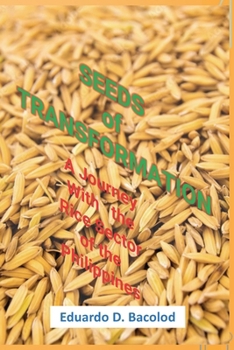
Seeds of Transformation: A Journey Through the Rice Sector of the Philippines
No Customer Reviews

The novel chronicles the journey of Magtanggol Ibarra, a development planner by training and experience, an aspiring historian, and an independent book publisher. He was also actively involved in the planning and implementation of the Philippines' rice program during the 1990s. Hailing from the university town of Mu oz, Nueva Ecija, Ibarra's life and career are closely linked to PhilRice and the Department of Agriculture. He played a key role in shaping policies and contributing to the development of national rice programs aimed at improving the lives of Filipino rice farmers. A strong advocate for scaling up various components of the sector to address evolving challenges, Ibarra even wrote a proposal to transform PhilRice into a financially self-sufficient government-owned entity-a forward-thinking vision that was ahead of its time. However, beyond his professional achievements and the present state of the rice sector, Ibarra harbors a deep personal mission: to put together in a script the untold stories of the rice sector of the Philippines, its struggles, triumphs, and its pivotal role in the country's history. This journey is not only about revisiting the past but also about envisioning a future for the rice sector that aligns with both modern innovations and the cultural heritage of Filipino rice farming. For Ibarra, it was disheartening that after more than 20 years away from the program, the true story had yet to be told, as no one had taken up where he left off. He felt strongly that his story needed to be shared, not only with those involved in the country's rice program but also with those searching for answers as to why the nation still struggles with rice self-sufficiency. Driven by a deep sense of responsibility to his heritage and the countless Filipinos who rely on rice farming for their livelihoods, Ibarra sets out on a mission to chronicle the history of the rice sector. He focuses on his hometown of Mu oz, Nueva Ecija, now a hub of rice technology innovation in the country. Leveraging his expertise as a researcher and development planner, he envisions narrating the story of the rice sector as a compelling movie script. His journey encompasses traditional agricultural practices, the history of the integrated rice production and milling business model, and his early exposure to rice experiments conducted by undergraduate students at CLSU. It also includes the emergence of government-supported initiatives and his involvement in rice sector development planning at PhilRice and the Department of Agriculture. These experiences shed light on the obstacles faced by farmers, the effects of various policies, and the innovations that have influenced the sector's growth and transformation. In a broader context, his experiences and perspectives could explain why the country is still not self-sufficient in rice.
Format:Paperback
Language:English
ISBN:B0DYVP45BJ
ISBN13:9798303209633
Release Date:February 2025
Publisher:Independently Published
Length:275 Pages
Weight:0.71 lbs.
Dimensions:9.0" x 0.7" x 6.0"
Customer Reviews
0 rating
Copyright © 2026 Thriftbooks.com
Terms of Use | Privacy Policy | Do Not Sell/Share My Personal Information | Cookie Notice | Cookie Preferences | Accessibility Statement
ThriftBooks ® and the ThriftBooks ® logo are registered trademarks of Thrift Books Global, LLC
ThriftBooks ® and the ThriftBooks ® logo are registered trademarks of Thrift Books Global, LLC
