


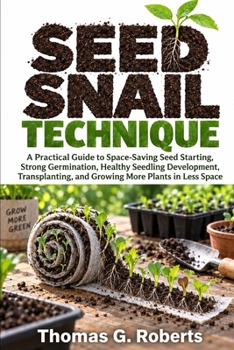
SEED SNAIL TECHNIQUE: A Practical Guide to Space-Saving Seed Starting, Strong Germination, Healthy Seedling Development, Transplanting, and Growing More Plants in Less Space

Seed Snail Technique is a practical guide to starting seedlings in less protected space while keeping germination quality, root health, sanitation, and transplant success at the center of the process.
Instead of treating the seed snail as a miracle method, Thomas G. Roberts shows readers how to use it as a compact propagation option and how to judge whether it truly fits a crop, growing space, and production goal. The book explains how to plan batches, choose wrapper materials and propagation media, build a stable soil-filled roll, sow at consistent depth and spacing, and maintain the balance of moisture and oxygen young roots need.
Inside, you will learn how to:
Plan sowing dates, seed quantities, spacing, and opening dates before rollingChoose suitable wrappers, propagation media, water, labels, and sanitation practicesBuild and sow a reliable soil-filled seed snail without overcompacting the root zoneManage temperature, lighting, airflow, moisture, and early nutritionRecognize damping-off, uneven emergence, stretching, algae, root tangling, and watering problemsMatch the method to vegetables, herbs, flowers, and different transplanting habitsOpen the roll, protect roots, grade seedlings, harden plants, and transplant successfullyMeasure labor, space use, usable transplant rate, and establishment before scaling the systemThe crop discussions include onions, leeks, brassicas, lettuce, tomatoes, peppers, eggplants, herbs, flowers, cucurbits, beans, peas, corn, and root crops, with clear guidance on when plug trays, individual cells, or direct sowing may be the better choice.
Ideal for small-space gardeners, market gardeners, nursery growers, homesteaders, greenhouse growers, and farmers experimenting with efficient propagation, Seed Snail Technique provides a disciplined way to build, test, troubleshoot, and improve this compact seed-starting system.
Customer Reviews
ThriftBooks ® and the ThriftBooks ® logo are registered trademarks of Thrift Books Global, LLC
