


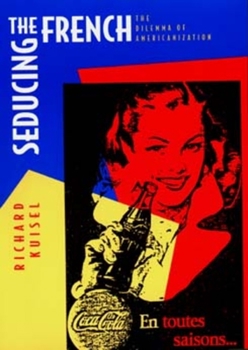
Seducing the French: The Dilemma of Americanization


Select Format
Select Condition 
Book Overview
When Coca-Cola was introduced in France in the late 1940s, the country's most prestigious newspaper warned that Coke threatened France's cultural landscape. This is one of the examples cited in Richard Kuisel's engaging exploration of France's response to American influence after World War II. In analyzing early French resistance and then the gradual adaptation to all things American that evolved by the mid-1980s, he offers an intriguing study of national identity and the protection of cultural boundaries.
The French have historically struggled against Americanization in order to safeguard "Frenchness." What would happen to the French way of life if gaining American prosperity brought vulgar materialism and social conformity? A clash between American consumerism and French civilisation seemed inevitable.
Cold War anti-Communism, the Marshall Plan, the Coca-Cola controversy, and de Gaulle's efforts to curb American investment illustrate ways that anti-Americanization was played out. Kuisel also raises issues that extend beyond France, including the economic, social, and cultural effects of the Americanized consumer society that have become a global phenomenon.
Kuisel's lively account reaches across French society to include politicians, businessmen, trade unionists, Parisian intelligentsia, and ordinary citizens. The result reveals much about the French--and about Americans. As Euro Disney welcomes travellers to its Parisian fantasyland, and with French recently declared the official language of France (to defend it from the encroachments of English), Kuisel's book is especially relevant.
Format:Paperback
Language:English
ISBN:0520206983
ISBN13:9780520206984
Release Date:January 1997
Publisher:University of California Press
Length:293 Pages
Weight:1.01 lbs.
Dimensions:0.8" x 6.0" x 8.9"
Customer Reviews
2 ratings
Fascinating Study, Obvious Conclusions
Published by Thriftbooks.com User , 21 years ago
Richard Kuisel ponders whether the so called "seduction" of the French people my the material based consumer society of America in the years since World War II has caused the French to lose their identity, or "Frenchness." "Curiosity as to why the French once perceived America so harshly and later seemed to succumb to the American way of life," writes Kuisel, " is a natural response for an American historian who has studied and lived in France" The key word here is "seemed." After reading a little over two hundred pages of Professor Kuisel's book the foregone conclusion and obvious answer to the query he posed in the Preface is no, the French did not lose their Frenchness. The French did not "succumb to the American way of life" by drinking Coca-Cola, watching Hollywood films or listening to American Jazz any more than Americans would lose their identity by driving Japanese automobiles or sporting Italian shoes. If this conclusion seems obvious, it is! Mr. Kuisel has written a significant study, and enjoyable read, however, in the process, he has not shattered any existing historical or sociological paradigms. The author has divided his study of the French reaction to modernization and America in the post-war years into three categories: intellectual, economic, and cultural considerations. The strength of Kuisel's book lies in the placing of French sentiment towards the Americans in historical context. Yet this strength contains a dual nature and perhaps conceals a hidden weakness. On the one hand, placing anti-American outlooks within the context of Cold War politics reveals legitimate reasons for French emotions running high. France, as well as West Germany, stood in between to armed camps. If a cataclysmic Third World War was going to eventually come about, France, as was the case in the previous two global conflicts, would once again become a battlefield. This should be a realization for those who have come to believe that the French just hate Americans period. On the other hand, however, a vast majority of anti-Americanism was coming from a logical place: Leftist propaganda via "Le Monde" and other predominantly Leftist publications. Although Kuisel admits that anti-American feelings existed on the Right as well, he fails to provide an adequate comparative political analysis. The result of this omission is, once again, an obvious conclusion for the source of Anti-American sentiment, rather than an astonishing revelation. The French Communists also played an influential role in trying to ban the import of Coca-Cola. The author provides an impressive explanation of the arguments against the importing of the famous American soft drink. French farmers and wine growers as well as other soft drink manufacturers had a legitimate gripe against the possible consequences of an influx of Coca-Cola, yet in the long run, the Communists exhausted their political machinations and American pressure won out. The battle with Coca-Cola was purely political and
Intriguing study of a touchy subject
Published by Thriftbooks.com User , 26 years ago
This book does a very good job of explaining why, more than other Europeans, many French get hot under the collar about American economic and cultural "imperialism". It is particularly strong on the period from the late 1940s to the early 1970s. Some readers might feel that Kuisel could have developed in greater detail his concluding argument that it's all about the fact that France and America are really the only two countries in the world with a feeling that they have a "universal message". This is surely the heart of the matter. Also, from the perspective of 2000, his rather upbeat chapter about how the French became significantly more pro-American toward the end of the last century looks in need of adjustment. But it's definitively recommended reading.
Copyright © 2026 Thriftbooks.com
Terms of Use | Privacy Policy | Do Not Sell/Share My Personal Information | Cookie Notice | Cookie Preferences | Accessibility Statement
ThriftBooks ® and the ThriftBooks ® logo are registered trademarks of Thrift Books Global, LLC
ThriftBooks ® and the ThriftBooks ® logo are registered trademarks of Thrift Books Global, LLC
