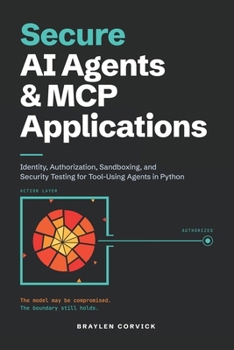
Secure AI Agents & MCP Applications: Identity, Authorization, Sandboxing, and Security Testing for Tool-Using Agents in Python

Prompt injection cannot be fully prevented by a better system prompt. Once an agent can call tools, read inboxes, open pull requests, or move money, security becomes an action problem: who is acting, with what authority, under what limits, and with what evidence. This book shows you how to build that control layer in Python.
Who this book is forPython developers and AI/ML engineers shipping tool-using agentsPlatform and security engineers building or reviewing MCP serversApplication-security teams that must sign off on agent deployments
What you will build and learnAgent identity and delegation: short-lived credentials and OAuth 2.1 token exchange so agents never hold standing secretsPolicy as code for every tool call: fine-grained authorization with a ready-to-use policy libraryHuman approval that holds up: approvals bound to the exact action, arguments, and contextMCP authorization end to end: PKCE, protected resource metadata, and token exchange per the 2026-07-28 specificationTool supply-chain defense: detecting tool poisoning, rug pulls, and shadowing, and pinning what you trustContainment: exfiltration controls, memory protection, sandboxing, and runtime limits for a compromised agentProof: security observability, audit evidence, CI/CD security gates, incident response, and passing the security review
What makes it different
Most AI-security books describe risks. This one assumes the model is already hostile. You will test your agent against a deliberately compromised model and verify invariants that must hold regardless of what the model says: no unapproved high-risk action, no credential escape, no silent data egress, and a complete audit trail.
18 chapters in 5 parts, 41 figures, 43 tables, and 118 code listings8 appendices: production-readiness checklist, MCP security checklist, threat-modelling worksheet, testing matrix, policy library, incident runbook, framework adapters, and version matrixControls mapped to the OWASP Top 10 for Agentic Applications (2026) and the OWASP Top 10 for LLM Applications (2025)Companion code
Every pattern is implemented in Wardgate, an open-source reference control layer on GitHub (Python 3.12-3.14, MCP Python SDK 2.2, container sandbox, CI security gates, and an evidence pack you can adapt for your own review).
Ship agents your security team can approve. Scroll up and get your copy.
Customer Reviews
ThriftBooks ® and the ThriftBooks ® logo are registered trademarks of Thrift Books Global, LLC