


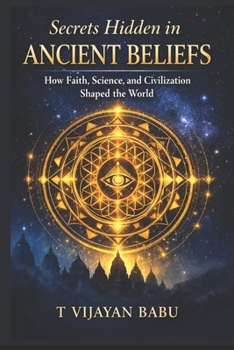
Secrets Hidden in Ancient Beliefs: How Faith, Science, and Civilization Shaped the World

Belief is one of the most powerful forces in human history, shaping how civilizations rise, how knowledge evolves, and how individuals understand their place in the universe. This book explores belief not as blind faith or rigid doctrine, but as a living human faculty that has guided thought, culture, science, and society from the earliest ages to the modern world.
Beginning with the first beliefs formed by the human mind, the book traces how instinct, fear, wonder, and imagination gave birth to symbols, myths, and shared meanings. These early beliefs helped humans interpret nature, confront mortality, and transform survival into civilization.
The narrative then expands to cosmic beliefs and creation myths across cultures, examining how ancient societies understood time, order, and the universe. Rather than treating myths as superstition, the book reveals them as symbolic systems that preserved observation, ethics, and early scientific insight.
Moving from the heavens to the Earth, the book explores sacred geography, temples, pilgrimages, and mythical lands. It shows how belief shaped landscapes into centers of knowledge and collective memory, binding communities through shared sacred space.
The focus then shifts to social beliefs that structured human life-hierarchy, justice, gender roles, family, law, and moral responsibility. These chapters reveal how belief created order, regulated behavior, and sustained societies long before modern institutions emerged.
The book further examines belief as the foundation of learning, healing, and early science. From ritual medicine to written knowledge, it uncovers how belief and reason worked together to advance understanding rather than stand in opposition.
Turning to the modern age, the book investigates beliefs that still govern contemporary life-money, technology, ideology, nationhood, and power. It reveals how belief has migrated from temples to systems, shaping empires, conflicts, and collective identity.
The later sections confront humanity's deepest concerns: life, death, the soul, the afterlife, immortality, and the fear of extinction. These chapters show how ancient beliefs continue to influence modern psychology, ethics, and the search for meaning.
Finally, the book looks ahead to the future of belief in an age of artificial intelligence, virtual reality, and transhumanism. It asks whether belief will disappear or evolve, concluding that belief remains humanity's compass-guiding choice, responsibility, and meaning in an increasingly complex world.
Customer Reviews
ThriftBooks® and the ThriftBooks® logo are registered trademarks of Thrift Books Global, LLC
