


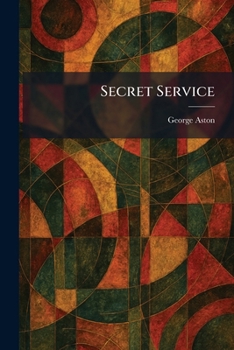
Secret Service

Select Format
Select Condition 
Book Overview
"Secret Service" by Sir George Aston offers an authoritative exploration into the clandestine world of international intelligence and military strategy. Written by a distinguished officer and historian with firsthand experience in the upper echelons of the British military, this work examines the evolution and impact of espionage from the late nineteenth century through the conclusion of the First World War.
The narrative delves into the organizational structures of secret service departments, the methods used to collect and analyze information, and the critical role that naval and military reconnaissance played in national security. Aston provides a detailed account of how intelligence-gathering transitioned into a sophisticated arm of the modern state, highlighting the coordination required between various branches of the armed forces to protect vital national interests. By documenting the successes and challenges of covert operations, "Secret Service" remains a significant historical study of the hidden forces that shape global conflict and diplomacy. It is an essential read for those interested in the history of spying, military intelligence, and the strategic underpinnings of early twentieth-century warfare.
This work has been selected by scholars as being culturally important, and is part of the knowledge base of civilization as we know it. This work was reproduced from the original artifact, and remains as true to the original work as possible. Therefore, you may see the original copyright references, library stamps (as most of these works have been housed in our most important libraries around the world), and other notations in the work.
This work is in the public domain in the United States of America, and possibly other nations. Within the United States, you may freely copy and distribute this work, as no entity (individual or corporate) has a copyright on the body of the work.
As a reproduction of a historical artifact, this work may contain missing or blurred pages, poor pictures, errant marks, etc. Scholars believe, and we concur, that this work is important enough to be preserved, reproduced, and made generally available to the public. We appreciate your support of the preservation process, and thank you for being an important part of keeping this knowledge alive and relevant.
Customer Reviews
ThriftBooks ® and the ThriftBooks ® logo are registered trademarks of Thrift Books Global, LLC
