


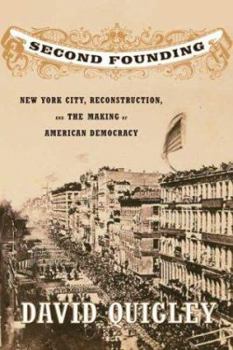
Second Founding: New York City, Reconstruction, and the Making of American Democracy

Select Format
Select Condition 
Book Overview
A striking new assessment of New York's place in our nation's political history At the close of the Civil War, Americans found themselves drawn into a new conflict, one in which the basic shape of the nation's government had to be rethought and new rules for the democratic game had to be established. In this superb new study, David Quigley argues that New York City's politics and politicians lay at the heart of Reconstruction's intense, conflicted drama. In ways that we understand all too well today, New York history became national history. The establishment of a postwar interracial democracy required the tearing down and rebuilding of many basic tenets of American government, yet, as Quigley shows in dramatic detail, the white supremacist traditions of the nation's leading city militated against a genuine revision of America's racial order, for New York politicians placed limits on the possibilities of true Reconstruction at every turn. Still, change did occur and a new America did take shape. Ironically, it was in New York City that new languages and practices for public life were developing which left an indelible mark on progressive national politics. Quigley's signal accomplishment is to show that the innovative work of New York's black activists, Tammany Democrats, bourgeois reformers, suffragettes, liberal publicists, and trade unionists resulted in a radical redefinition of reform in urban America.
Format:Hardcover
Language:English
ISBN:0809085143
ISBN13:9780809085149
Release Date:January 2003
Publisher:Hill and Wang
Length:256 Pages
Weight:2.05 lbs.
Dimensions:8.3" x 0.7" x 5.5"
Customer Reviews
4 ratings
Essential reading
Published by Thriftbooks.com User , 19 years ago
Reconstruction is so often taught and remembered as something Southern; New York in this era is usually thought of in terms of Northern industrialization and Gilded Age values. What David Quigley does is nothing less than force us to rethink this entire period of American history and see New York as the center of our modern political order. Essential reading--this is a book that will eventually reshape the way this period is taught.
New York and the legacy of racism
Published by Thriftbooks.com User , 21 years ago
We naturally associate the Mason-Dixon line with the obvious divisions of ideology, and yet the case of none other than New York City is not so simple. This history of New York during the Civil War and Reconstruction shows a side we easily forget, from the infamous Draft riots to the age of Tilden and the end of reconstruction. In fact the struggle for racial tolerance nearly failed as the tide of Reconstruction past and the anti-democratic elites of the Gilded Age created the status quo that endured until the twentieth century.
A great work
Published by Thriftbooks.com User , 21 years ago
Dr. Quigley launches his first work as if he were a veteran. Second Founding relays insight into the reconstruction of this country that is often overlooked and most times forgotten. However, the decisions made in the decade following the Civil War still maintain a powerful presence to this day. Quigley offers some very original insight into the events of New York City and how they ran parallel with and often shaped and formed the political events of the rest of the country. After reading this book, no one can question the reality of New York's leadership in national politics then and now. This book reads as smooth as a novel with the depth of a textbook. A must read!
Reconstruction and the City
Published by Thriftbooks.com User , 22 years ago
I'd read Quigley & Gellman's JIM CROW NEW YORK and liked it. This book builds off of the last sections of that book and tells the New York side of the civil war and reconstruction. Quigley does a good job explaining the city's ugly racial history by looking at the years after the draft riots. I really liked the chapter on election day in 1870 and the way federal troops were deployed. The final section on Grant's tomb makes you think about how reconstyruction continued, or maybe continues.
Copyright © 2026 Thriftbooks.com
Terms of Use | Privacy Policy | Do Not Sell/Share My Personal Information | Cookie Notice | Cookie Preferences | Accessibility Statement
ThriftBooks ® and the ThriftBooks ® logo are registered trademarks of Thrift Books Global, LLC
ThriftBooks ® and the ThriftBooks ® logo are registered trademarks of Thrift Books Global, LLC
