


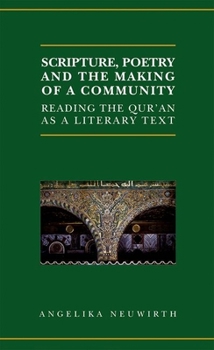
Scripture, Poetry, and the Making of a Community
No Customer Reviews

We are used to understanding the Qur'an as the "Islamic text" par excellence, an assumption which, when viewed historically, is not evident at all. More than twenty years before it rose to the rank of Islamic Scripture, the Qur'an was an oral proclamation addressed by the Prophet Muhammad to pre-Islamic listeners, for the Muslim community had not yet been formed. We might best describe these listeners as individuals educated in late antique culture, be they Arab pagans familiar with the monotheistic religions of Judaism and Christianity or syncretists of these religions, or learned Jews and Christians whose presence is reflected in the Medinan suras. The interactive communication process between Muhammad and these groups brought about an epistemic turn in Arab Late Antiquity: with the Qur'anic discovery of writing as the ultimate authority, the nascent community attained a new "textual coherence" where Scripture, with its valorisation of history and memory, was recognised as a guiding concept. It is within this new biblically imprinted world view that central principles and values of the pagan Arab milieu were debated. This process resulted in a twin achievement: the genesis of a new scripture and the emergence of a community. Two great traditions, then, the Biblical, transmitted by both Jews and Christians, and the local Arabic, represented in Ancient Arabic poetry, appear to have established the field of tension from which the Qur'an evolved; it is both Scripture and Poetry which have produced and shaped the new Muslim community.
Format:Hardcover
Language:English
ISBN:0198701640
ISBN13:9780198701644
Release Date:January 2015
Publisher:OUP in Association with the Institute of Isma
Length:704 Pages
Weight:2.02 lbs.
Dimensions:1.6" x 6.1" x 9.3"
Customer Reviews
0 rating
Copyright © 2026 Thriftbooks.com
Terms of Use | Privacy Policy | Do Not Sell/Share My Personal Information | Cookie Notice | Cookie Preferences | Accessibility Statement
ThriftBooks ® and the ThriftBooks ® logo are registered trademarks of Thrift Books Global, LLC
ThriftBooks ® and the ThriftBooks ® logo are registered trademarks of Thrift Books Global, LLC
