


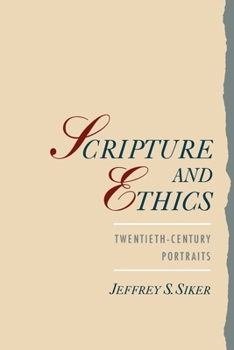
Scripture and Ethics: Twentieth-Century Portraits


Select Format
Select Condition 
Book Overview
How should the Bible be used in Christian ethics? Although this question has been addressed many times, little attention has gone to how the Bible actually has functioned in constructing theological ethics. In this book, Siker describes and analyzes the Bible's various uses in the theology and ethics of eight of the twentieth century's most important and influential Christian theologians: Reinhold Niebuhr, H. Richard Niebuhr, Bernhard Haring, Paul Ramsey, Stanley Hauerwas, Gustavo Gutierrez, James Cone, and Rosemary Radford Ruether. Of each author Siker asks five related questions: which biblical texts does the author in fact use; in what ways are the texts used; how does the author envision the authority of the Bible; what kind of hermeneutic does the author employ; and what has each author's approach to the Bible yielded in terms of Christian ethics? Siker ends each chapter with a critical evaluation of the various problems and prospects for the author's use of Scripture, and concludes the study with a comparison and contrast of the authors' respective appropriations of the Sermon on the Mount.
Format:Paperback
Language:English
ISBN:0195110994
ISBN13:9780195110999
Release Date:December 1996
Publisher:Oxford University Press
Length:304 Pages
Weight:1.05 lbs.
Dimensions:0.8" x 6.1" x 9.1"
Customer Reviews
1 rating
An excellent resource !
Published by Thriftbooks.com User , 26 years ago
New Testament scholar Jeffrey Siker has done a good service to both biblical scholars and theological ethics by examining the actual use of Scripture in eight of the most influential 20th C. Christian theologians writing on ethical issues. The student of Christian ethics is struck by some notable omissions (perhaps, most obviously, that of Walter Rauschenbusch), but no work can cover everyone and Siker's treatment invites similar investigations. He gives capsule summaries of the major works and themes of each of his exemplars before examining what biblical passages are regularly cited, how they are used, to what extent the theologian in question interacted with critical biblical scholarship, and the conclusions drawn. His comparisons and conclusions are insightful. As a Christian ethicist trained also in biblical studies, I noticed one conclusion of Siker's that was greatly affected by his choice of figures to examine. Siker notes that Christian theological ethics is seldom very informed by close interaction with New Testament scholarship and vice versa. He laments the narrow "turf" protection in academics that is largely responsible for this lack. While his conclusion and lament both seem accurate, there are a number of theological ethicists who are giving more attention to critical biblical scholarship and a number of biblical scholars giving increasing attention to ethical dimensions of the biblical materials. In both cases, these numbers appear to be growing, though they remain small.While not flawless, Siker's work is significant and is highly recommended.
Copyright © 2026 Thriftbooks.com Terms of Use
| Privacy Policy | Do Not
Sell/Share My Personal Information | Cookie Policy | Cookie Preferences | Accessibility Statement
ThriftBooks® and the ThriftBooks® logo are registered trademarks of Thrift Books Global, LLC
ThriftBooks® and the ThriftBooks® logo are registered trademarks of Thrift Books Global, LLC
