
Skip to content
Scan a barcode
Scan
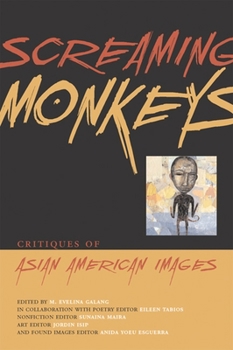
Paperback Screaming Monkeys: Critiques of Asian American Images Book

ISBN: 1566891418

ISBN13: 9781566891417

Screaming Monkeys: Critiques of Asian American Images

Select Format

Select Condition ThriftBooks Help Icon

Recommended

Format: Paperback

Condition: Very Good*

*Best Available: (ex-library)

$7.49
Save $14.51!
List Price $22.00
Almost Gone, Only 1 Left!
Save to List

Book Overview

When a restaurant review referred to a Filipino child as a "rambunctious -little monkey," Filipino Americans were outraged. Sparked by this racist incident, Screaming Monkeys sets fire to Asian American stereotypes as it -illuminates the diverse and often neglected history and culture within the Asian American diaspora. Poems, essays, paintings, and stories break down and challenge "found" articles, photographs, and headlines to create this powerful anthology with all the immediacy of social protest. By closely critiquing a wealth of material, including the judge's statement of apology in the Wen Ho Lee case, the media treatment of serial killer Andrew Cunanan, and the image of Asian Americans in major U.S. marketing campaigns, Screaming Monkeys will inspire all its readers.

Customer Reviews

1 rating

PALH-EZINE'S REVIEW (by Rocio G. Davis)

Screaming Monkeys enacts one of the most challenging, yet culturally rewarding, subversions of prevailing stereotypes of Asian Americans in contemporary mass media. The title of the anthology comes from a controversial incident that sparked the editor's anger: in a restaurant review published in Milwaukee Magazine in 1998, the reviewer calls a young Filipino American boy a "rambunctious little monkey," leading to a flurry of indignant responses by Asians. The key issue was simple: the writer's ignorance of Filipino and Filipino American history led her to frivolously write what she probably considered a cute anecdote. How exceedingly misguided she was is evidenced by this amazing anthology, a dramatic work of creativity and resistance to uninformed cultural categories and a vital document that professors of Asian American studies or anyone interested in the complex history of Asians in America will appreciate. Sunaina Maira, noting the "rise of Indo-chic" in the last couple of years, "part of a wider marketing of `Asian cool' in fashion, music, and film," asks the crucial question: "So what kinds of representations do we, and can we, construct in response?" Here is the answer: M. Evelina Galang and her amazing team of editors have constructed an anthology of a wide range of texts and images that illustrate how Asian America has been uncritically represented in the media and in art, to challenge those representations with art itself. The juxtaposition of creative modes-fiction, poetry, essay, art with advertisements and critical pieces-provides a nuanced perspective of the vexed position of Asian Americans in mainstream America, and obliges us to rethink our manner of cultural classifications. The range and quality of the contributions is to be applauded-texts by established writers such as Carlos Bulosan, Maxine Hong Kingston, Gish Jen, Hisaye Yamamoto, and Li-Young Lee dialogue with work by young artists, "found" images and texts that include a Skyy Vodka ad, a photograph of Madonna "channeling her inner geisha" (488), a reproduction of a Newsweek article from 2000 that claims that Asian men are the latest trophy boyfriends, Bill Clinton's apology to Japanese America, and critical or personal essays, like Wen Ho Lee's account of his interrogation by the CIA and an essay by David Mura where he explains why he's glad he didn't get a role in Fargo. As such, the anthology's vital metacritical design is to make Asian American voices (screams!) heard-loudly! These texts subvert stereotypical images by presenting them in a new strategic light: they show how the media invents, advocates, and sustains the stereotypes of Asians in America precisely because they have misunderstood, ignored or trivialized the presence of Asians in American history, culture, cities, sports, and entertainment. And it allows Asian Americans to speak for themselves, though an extraordinary assemblage of artistic modes. The selections are warm and funny, cynical and offensive, s
Copyright © 2026 Thriftbooks.com Terms of Use | Privacy Policy | Do Not Sell/Share My Personal Information | Cookie Policy | Cookie Preferences | Accessibility Statement
ThriftBooks ® and the ThriftBooks ® logo are registered trademarks of Thrift Books Global, LLC

GoDaddy Verified and Secured