


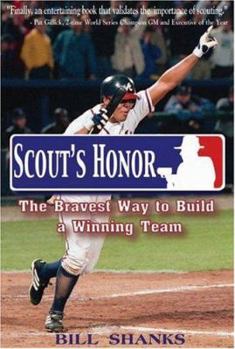
Scout's Honor: The Bravest Way To Build A Winning Ballteam

Using the Atlanta Braves as a focal point, Scout's Honor is an in-depth look at what instinct and gut reaction means to baseball and how the numbers-don't-lie style of the new breed is not only... This description may be from another edition of this product.
Format:Hardcover
Language:English
ISBN:0976637219
ISBN13:9780976637219
Release Date:March 2005
Publisher:Sterling & Ross Pub Inc
Length:378 Pages
Weight:1.46 lbs.
Dimensions:9.0" x 1.5" x 6.3"
Customer Reviews
5 ratings
Who said he doesn't define makeup?
Published by Thriftbooks.com User , 20 years ago
This is a great book, especially if your an Atlanta Braves fan, as it is particularly groomed for these fans. However, anyone who has a passion for baseball should love this book. In regards to the reviewer who said the book is ruined for you because Shanks never defines makeup, perhaps you should take a glance at page 16, and check out that paragraph that's clearly indicated with a baseball above it, highlighting its importance. "The Braves are what you call in the game of baseball, an old school organization. Radar guns and stopwatches are always in use, and of course they'll check out the stats. But there's a personal side that's more important to this gang. They believe in getting to know their potential players. What's he like off the field? Is he a winner? Can he handle adversity? Can he handle winning and losing? Does he hustle? What's his desire? What's his attitude? What's his personality? Is he coachable? Does he have heart? This is makeup. It defines the character of a ballplayer." Perhaps you should go back and reread this one mate, seems like you dropped the ball.
Keeping a Major League Team Supplied with Winners
Published by Thriftbooks.com User , 21 years ago
There are a lot of ways to build a winning baseball (or any other kind of) team. The problem is that it's impossible to quantify a lot of things. (McNamara tried to use numbers for everything and we got the Viet Nam war.) There is a school that teaches that metrics are the only thing to consider. There's another school that says that metrics can't measure teamwork, drive, or as this book calls it 'makeup.' This book, by long time Braves following journalist Bill Shanks follows the Braves way of using professional baseball scouts as they go looking for players with the right makeup. The book is a series of anecdotes and stories that illustrate how the Braves do something that basically can't really be defined, that is, attract each year a stable of competent players, run them through their farm team system to keep a major league ball team supplied with competent players year after year. This book uses the Braves as examples because they use the scout system. It would be equally useful for other teams, but using one team as an example gives better consistency in a story. Highly recommended, especially if you're a Braves fan.
One of a kind to be sure.
Published by Thriftbooks.com User , 21 years ago
I was watching the Mets game a few weeks ago when they were playing the Braves and the announcers mentioned this book as a source to explain who all these 'no-names' on the field were for the Braves. One of them said that the Braves were epitomized in this book as THE organization to look at for their emphasis and reliance on scouts. So I ordered it. Firstly, I expected to read on every page how Moneyball was this evil empire since I'd read some online posts about the fact that this was the answer to Moneyball, and it sort of is, but Moneyball is not even mentioned until the last Chapter under "The Moneyball Influence." So I guess all the Moneyball cheerleaders must be working overtime spinning this book as completely off-base. Instead what it does is shine a very bright light on the way a very successful baseball franchise develops and rates talent. That's all-- nothing more and nothing less, until the last chapter when Shanks does tear into the Moneyball book. But heck, that book needed tearing into-- and it should have come two years ago. Can you say, "Emperor Beane has no clothes?" What the author doesn't do is preach. Shanks simply uses the words of hundreds of other players and management to forward the thesis that many teams are now using that 'makeup' is the best way (I guess "bravest" way) to determine talent. I had to laugh when I read that this book lacked substance-- all it has is substance. If you look at the Index there are over a thousand players and management personel listed there. If that's not substance, substance doesn't exist. I love the fact that this book takes a hypothesis and backs it up with the words of hundreds of other people. We need more of that substance and less of the shills who, "because I said it means it's true." Lastly, I wonder what Joe Torre thought of that picture of him from the 70's? He hasn't really changed in 30 years.
Baseball fans must read!
Published by Thriftbooks.com User , 21 years ago
As a dedicated (sadly) Reds fan, but a baseball fan first and foremost, I was very surprised to be hyponotized by the Scout's Honor book. I thought it would be just a manifesto for Braves fans, but it turns out that there are a number of great stories and players that were involved in the making of this book, covering the entire MLB in the process. I see that Scout's uses the Braves as the focal point to make the case for the value of scouting vs. Moneyball's use of the A's for their book. But it reads very well, bringing the entire run of the Braves into focus, documenting how that juggernaut was built, which was incredibly dependant on scouting and development. I have long been a fan of Bill James (my 1983 Baseball Abstract was quite worn, and my '83 Topps baseball cards all had some percentage on the back, an outcome of the Favorite Toy. Moneyball made some impressive points about doing more with less, something I wish my Reds had done time and time again. But their implication that scouting was obsolete was something that I couldn't completely buy into. Scout's Honor shows that scouting shows to be a more longer lasting was to build a franchise, again something I wish the Reds would do time and time again (at one point, Reds fans will always recall, Marge Schott famously said that scouts were fat and all they did was watch ballgames). Scout's Honor made excellent points about the Braves way and how it was born of many men from different franchises over the years. The stories from the people who spanned decades of baseball and the players in the majors and minors today, made for can't-put-the-book down reading for me, and I would imagine any baseball fan like myself would feel the same way.
Finally, the other side of the coin. FOR ALL BASEBALL FANS.
Published by Thriftbooks.com User , 21 years ago
This book is touted as the long awaited answer to Michael Lewis' best-seller MONEYBALL, which outlined a way to determine talent based on an 'alternative' to old-fashioned scouting- namely creative number crunching, reliance on on-base-percentage, and new ways to look at the numbers, as well as the emphasis on college players. In almost every way this book outlines the antithesis to the methods applied by the A's and others that Moneyball made famous (and by the current ranking of Scouts Honor at #14 best-selling sports book this book is not far behind). SCOUTS HONOR shows how the Braves draft a majority of high-school kids, value speed and defense (which Moneyballers do not- "why try and steal a base when you could get thrown out"), and rely on their scout's instinct of 'makeup' as the key factor in determing talent. What I find HILARIOUS is the people who have criticized this book because it doesn't describe how these scout's determine makeup other than by instinct. That's the whole point! IT'S A TALENT. The average shlub off the street CANNOT do what these people do, is the point Shanks is trying to make. Anyone knows that a 9 is higher than an 8. With that extent of knowledge anyone can be a major league General Manager if all you care about is numbers. These scouts have these instincts about what 'makes up' talent, and no MBA from Stanford has that ability out of the chute. Shanks is very clear in stating that numbers obviously have their place in the Braves' organization, but they are relied upon FAR less than with other teams. The benefit of the method that teams like the Braves, Brewers, Reds, Cardinals, Royals and Twins have is these guys, these scouts, who are relied upon to determine talent by looking into the FUTURE (as some writer from MLB.com writes on the back of the book) while people who rely on numbers are relying on the PAST. If you had a crystal ball into the future and you were a General Manager, would you rather use that crystal ball or rely on the past as an indicator of how successful your player was going to be in the future? I think it's rather obvious. One of Shanks' points is that these scouts are simply baseball crystal balls. Now, why not use these people? Because numbers are defensible and safe. When you draft someone based on their OBP or ANY OTHER NUMBER, everyone on planet earth knows why you took that player. The number is right there for everyone to see. When you take or trade a player based on instinct, it's very indeterminate, there is nothing specific to point to other than you 'like' or 'dislike' his makeup. Statheads and insecure people can't handle that-- they have to be able to put their hands on something, to point to a spreadsheet, because that covers their butts. Shanks explains that in scouting, you don't have anything covering your butt-- it's your instinct on the line, and that's scary to most people. But that's a pretty darn brave way to build a team, because you're putting your butt on the li
Copyright © 2026 Thriftbooks.com
Terms of Use | Privacy Policy | Do Not Sell/Share My Personal Information | Cookie Notice | Cookie Preferences | Accessibility Statement
ThriftBooks ® and the ThriftBooks ® logo are registered trademarks of Thrift Books Global, LLC
ThriftBooks ® and the ThriftBooks ® logo are registered trademarks of Thrift Books Global, LLC
