


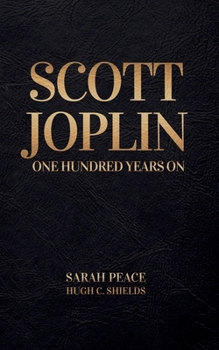
Scott Joplin One Hundred Years On
No Customer Reviews

A centennial commemoration of the life of Scott Joplin, famed as the King of Ragtime.
The melody is unmistakable. It is a syncopated masterpiece that has provided the background music for over a century of American life. Yet, while the jaunty notes of The Entertainer are etched into the global subconscious, the architect who drafted them remains a shadow in his own story. This centenary essay seeks to right that imbalance. It re-examines the life of Scott Joplin, not merely as a pioneer of ragtime, but as an eminent master composer whose ambitions reached far beyond the piano stool.
Joplin was not merely a casualty of his circumstances but a navigator who steered his legacy through them. He treated his talent as a form of capital, proving that excellence is a proactive choice rather than a fortunate accident. In an era of profound structural barriers, he demonstrated that the most effective tool of liberation is the cultivation of an undeniable and sovereign intellect. By placing Joplin's career at the intellectual crossroads of the early twentieth century, this work reveals a man who was a shrewd strategist of his own worth. Joplin engineered a path between the pragmatic conservatism of Booker T. Washington and the systemic agitation of W.E.B. Du Bois. Even when institutional doors were barred, Joplin engineered his own entrance. He understood that while physical manuscripts can be lost to the shroud of obscurity, the human capital of a highly developed mind creates a value that no political landscape can devalue. His life serves as a philosophical case study in the power of self-mastery as a prerequisite for true freedom. It is a message that carries deep resonance for today's fraught political landscape, offering a timeless perspective on the quest for Black liberation. Joplin's greatest compositions were not merely a collection of catchy tunes, but a blueprint for cultural sovereignty. The same spirit that propelled his ragtime onto the grand operatic stage would later drive Jazz and Hip Hop from the margins of society to permeate the homes of those who once denigrated it. One hundred years on from his demise, the invisible genius is unveiled as the visionary who earned his crown as the King of Ragtime.Publisher's note: This book is written and formatted in standard British English. Readers may notice regional variations in spelling and punctuation.Format:Paperback
Language:English
ISBN:0993175139
ISBN13:9780993175138
Release Date:April 2017
Publisher:Doubleu
Length:122 Pages
Weight:0.20 lbs.
Dimensions:0.3" x 5.0" x 8.0"
Customer Reviews
0 rating
Copyright © 2026 Thriftbooks.com Terms of Use
| Privacy Policy | Do Not
Sell/Share My Personal Information | Cookie Policy | Cookie Preferences | Accessibility Statement
ThriftBooks® and the ThriftBooks® logo are registered trademarks of Thrift Books Global, LLC
ThriftBooks® and the ThriftBooks® logo are registered trademarks of Thrift Books Global, LLC
