


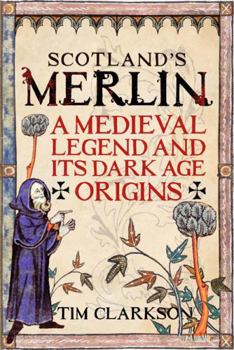
Scotland's Merlin: A Medieval Legend and Its Dark Age Origins


Who was Merlin? Is the famous wizard of Arthurian legend based on a real person? In this book, Merlin's origins are traced back to the story of Lailoken, a mysterious 'wild man' who is said to have lived in the Scottish Lowlands in the sixth century AD. The book considers the question of whether Lailoken belongs to myth or reality. It looks at the historical background of his story and discusses key characters such as Saint Kentigern of Glasgow and King Rhydderch of Dumbarton, as well as important events such as the Battle of Arfderydd.
Lailoken's reappearance in medieval Welsh literature as the fabled prophet Myrddin is also examined. Myrddin himself was eventually transformed into Merlin the wizard, King Arthur's friend and mentor. This is the Merlin we recognise today, not only in art and literature but also on screen. His earlier forms are less familiar, more remote, but can still be found among the lore and legend of the Dark Ages. Behind them we catch fleeting glimpses of an original figure who perhaps really did exist: a solitary fugitive, tormented by his experience of war, who roamed the hills and forests of southern Scotland long ago.
Lailoken's reappearance in medieval Welsh literature as the fabled prophet Myrddin is also examined. Myrddin himself was eventually transformed into Merlin the wizard, King Arthur's friend and mentor. This is the Merlin we recognise today, not only in art and literature but also on screen. His earlier forms are less familiar, more remote, but can still be found among the lore and legend of the Dark Ages. Behind them we catch fleeting glimpses of an original figure who perhaps really did exist: a solitary fugitive, tormented by his experience of war, who roamed the hills and forests of southern Scotland long ago.
Format:Paperback
Language:English
ISBN:1906566992
ISBN13:9781906566999
Release Date:July 2016
Publisher:John Donald Publishers
Length:192 Pages
Weight:0.84 lbs.
Dimensions:0.7" x 6.1" x 9.1"
Customer Reviews
1 rating
An Interesting Hypothesis !
Published by RobRoy Nevada , 9 months ago
A very detailed interesting hypothesis on the historical origins of the person believed that Geoffery of Monmouth turned into Merlin. The author makes a convincing argument for the Scottish Borderland origins of Merlin and that he was not a magician or a Druid but a warrior. A warrior who after the horrors of the Battle of Arfderydd disappears into the forests of "Calidon" returning as a seer and a prophet.
The author for whatever reason then decides to go down the "Merlin must have been a Christian" rabbit hole, without ever mentioning that warriors of the early Dark Ages were usually inducted into the cult of Mithras, and if his Merlin was a warrior then he'd at least nominally known about it or was a devotee. As Paganism was alive and well in Britain during that time period there's every chance Merlin could have also been a Pagan, but the author decided to make it a Christian Britons versus a Heathen Anglo-Saxon battle, the only logic reason must be the authors own religious preferences.
This was the only part of the book that I didn't particularly like.
Overall, I would recommend the book but with a healthy dose of salts when you get to the Christian versus Pagan section.
Copyright © 2026 Thriftbooks.com Terms of Use
| Privacy Policy | Do Not
Sell/Share My Personal Information | Cookie Policy | Cookie Preferences | Accessibility Statement
ThriftBooks® and the ThriftBooks® logo are registered trademarks of Thrift Books Global, LLC
ThriftBooks® and the ThriftBooks® logo are registered trademarks of Thrift Books Global, LLC
