


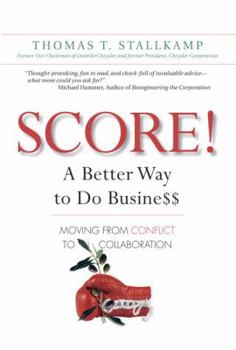
SCORE!: A Better Way to Do Business: Moving from Conflict to Collaboration

Select Format
Select Condition 
Book Overview
Enables Thomas Stallkamp's innovations to become as widely known as Michael Dell's. They are certainly as powerful. Thomas's insights into win-win supply chain relationships and in innovation through... This description may be from another edition of this product.
Format:Hardcover
Language:English
ISBN:0131435264
ISBN13:9780131435261
Release Date:January 2005
Publisher:Wharton School Pub
Length:228 Pages
Weight:1.10 lbs.
Dimensions:9.3" x 0.8" x 6.3"
Customer Reviews
5 ratings
There's No "I" in SCORE as Benefits Multiply Through Collaboration According to an Executive Who Kno
Published by Thriftbooks.com User , 20 years ago
If there is a corporation intimately familiar with the consequences of communications breakdowns, it's DaimlerChrysler, the high profile merger that rocked the automotive industry in 1998. Former vice chairman and president Thomas Stallkamp - who is given much of the credit for stabilizing the unwieldy result of the consolidated company - lucidly explains his proven collaborative management principles in a crisply written book. His timing seems especially appropriate given the encroaching dominance of China as a global economic power and the increasingly irrelevant ways in which companies traditionally manage their output and people, in particular, the manufacturing and industrial sectors. Collaboration is the key, according to Stallkamp, and the methodology he espouses is called the Score system. Although his open-communication model is based wholly within his automotive industry experience, he is quick to point out how applicable it is to any company. His model at Chrysler was an incentive program which encouraged suppliers to submit suggestions voluntarily with the goal of realizing cost reductions in doing business with Chrysler. The author goes into how-to mode with ease in describing how to monitor, measure, and track the results of a Score system. For such an idealistically conceived structure, he lends a welcome, credible realism to his perspective by not demanding that all the savings generated by supplier ideas be passed on to the company, that some should be kept by the suppliers to retain their own profit margins. The whole point is that both supplier and manufacturer benefits from the arrangement. Conversely, Stallkamp does not respect the management arrangement of most finance departments, which work on the principle of hoarding information, rather than sharing it. Stallkamp believes that the adversarial way of doing business prevails most in those industries like retail, the airlines and steel manufacturing, sectors that have been flailing for a while in this country because the myopic perspectives taken by the industry leaders have induced a self-cannibalization effect. With so many companies viewing their supply and demand chains exclusive of their competitors, there are opportunities to expand the category and evolve into an industry leader with Stallkamp's model. The author feels strongly that management needs to work against their tendencies to focus on demanding, information-exclusive ways of working even during crisis periods when reaching out is more important than ever, especially to customers. Much of the long-term success of the Score model depends on word-of-mouth around a specific company being a better place to do business. Only when that level of awareness occurs does Stallkamp see such a program being self-sustaining. Applying his thinking in the real world, his old company DaimlerChrysler just announced a new management model in late January 2006 which discussed process streamlining and a greater consolidation
The Power of First-Person Plural Pronouns
Published by Thriftbooks.com User , 20 years ago
The title is an acronym which refers to a proprietary goal and measurement system: Supplier Cost Reduction Effort. Stallkamp asserts (and I wholeheartedly agree) that "adversarial commerce" eventually creates a lose-lose situation. As he explains, "The behaviors Ford and General Motors exhibited...are examples of adversarial commerce. This term describes the negative and domineering manner many companies use to control their relationships in normal business dealings. Adversarial commerce is becoming increasingly common in the business world because it is based on using short-term leverage [e.g. cost slashing at the expense of suppliers] from the value of the business to produce equally quick results." In this context, I am reminded of an article written for The Wall Street Journal (October 21, 1993) in which Peter Drucker identifies and then discusses what he characterizes as "Five Deadly Sins": 1. "Worship of high profit margins and premium pricing" 2. "Mispricing a new product by charging what the market will bear" 3. "Cost-driven pricing" 4. "Slaughtering tomorrow's opportunity on the alter of yesterday" 5. "feeding problems and starving opportunities" Presumably Stallkamp is familiar with that article and agrees with Drucker that too many companies are committed to "adversarial commerce" to achieve short-term financial objectives at the substantial cost of their and their suppliers' long-term best interests. Hence the importance of SCORE. In 1990, Stallkamp was responsible for Chrysler's procurement and supply activities. "Although it took some time to get started, by 1992, the SCORE approach had been incorporated into a supply-management philosophy called the Extended Enterprise of the firm. Because their destiny and fortunes were directly linked to Chrysler's,, the idea was to build a virtual team atmosphere in which all parties focused on reducing the cost of developing and producing vehicles. The construction supply-side suggestions worked to reduce both the supplier's costs and those of Chrysler." In this book, Stallkamp traces with meticulous the process by which SCORE was formulated and then implemented as a proprietary goal and measurement system. He presents his material within 11 chapters, followed by an Appendix in which he provides supporting figures and attachments. By then, I was already convinced of the value of SCORE but this material may well be essential to those who must overcome the objectives of senior management in their respective organizations. The chapter subjects range from "Breaking the Mold" (e.g. the clash of opposite approaches discussed in Chapter 1) to "Breaking the Mold" (e.g. why managed collaboration is "the answer" discussed in Chapter 11). Obviously, as former Chrysler Corporation president and later vice chairman of DaimlerChrysler, Stallkamp speaks from his own extensive real-world experience. He has credibility when, for example, he identifies probable obstacles to "breaking the mold" an
Refreshing Concept, Credible, Well-Presented
Published by Thriftbooks.com User , 21 years ago
When we see books written by top executives who have paid their dues with vast experience, we pay attention. OK, some of them are put together by ghost writers, but the message is still credible and worth listening to. Stallkamp is a former president of Chrysler Corporation and former Vice Chairman of DaimlerChrysler. It's worth paying attention to this one. The premise presented by Stallkamp is simple: you attract more bees with honey than vinegar. It's a message we learned from our mothers as we were growing up. Now it's presented to us in a business context, with examples that bring the proverb to life. Stallkamp tells the story of how he developed a process at Chrysler that generated a strong sense of collaboration with suppliers, a partnership to continuously improve wherever possible. While this collaborative approach sounds like a no-brainer, many companies don't operate this way. Stallkamp tells the story of his counterpart at General Motors when he was head of procurement, who applied a very strong conflict model to manage supplier relationships. The adversarial commerce model didn't work, and Stallkamp's posture in this book is that it won't work-ever. Readers will learn about Stallkamp's model at Chrysler: SCORE. This name is an acronym for Supplier Cost and Reduction Effort. The experience demonstrated that cooperation produces substantially more long-term savings, as well as short-term gains. The collaborative relationship can be sustained; the adversarial cannot. You'll gain helpful insights into the collaborative process, read about examples in a number of industries, and be inspired to build positive relationships in your work. The relationship message is recurrent in business today, so this book reinforces prevalent thinking in the leadership field. Valuable read for senior leaders and company owners, as well as procurement specialists. The book includes messages that senior leaders need to convey throughout their organizations.
All Gain And No Pain
Published by Thriftbooks.com User , 21 years ago
It makes sense to approach business relationships as a partnership to make sure that both sides come away from the experience in a positive light, but how many times have you been involved in something the gets competitive and turns into a game of who can get the most out of the other guy. That is what this book is about. The authors premises is that in today's competitive and global environment with all the price pressures that there are, it is going to be relationships that are more important then squeezing that last 1 % out of your vendors. Sure this sounds like some sort of play nice book written by a non business professional that really does not know what it is like. That perception is incorrect. The author was the Vice Chairman of the Chrysler Corporation and practiced what he is laying out in the book. Overall he gives any number of examples of how win - win relationships help you out in the long run. He is a very persuasive author and his premises is helped out by the fact that deep down most if us know that he is correct. We all like working with people that make things easy and are treating us fairly and we all dislike the pain associated with dealing with a firm that you know will stick it to you unless you are on top of them. Overall I enjoyed the book. The author writes in a very easy to read and positive manner. The book reads at a fast pace and is full of insightful points. It is the kind of book that you wish all business professionals could read and put in practice. Not only does the book spell out a better way to do business, but it is the way to stay in business.
Required reading for executives who think bullying works
Published by Thriftbooks.com User , 21 years ago
SCORE is an acronym for Supplier COst Reduction Effort and is used to describe the policy of cooperating with suppliers, labor unions and other associated companies rather than being confrontational. Stallkamp is the former vice chairman of DaimlerChrysler and the former president of Chrysler Corporation. Therefore, his experience is in the auto industry, where the amounts are enormous and relationships can be complicated. His arguments, and they are persuasive, are that companies should establish partnerships with their suppliers and strong-arm tactics are self-destructive. He describes cases where executives of auto companies made threats to suppliers and dealers in an attempt to cut the costs to the Auto Company. This was predicated on the misguided belief that since the Auto Company had the financial clout, the other entities would be forced to acquiesce. While it worked for a short time, those being bullied were resistant and eventually the policy had to be rescinded. There was a complete loss of trust between the companies and it took some time before there was a restoration of the good faith needed to conduct business. I very much enjoyed this book, it is truly an example of how cooperation, even with rivals, can lead to improved conditions for all. Many of the points made in this book reminded me of the book, "The Evolution of Cooperation" by Robert Axelrod. Axelrod cites many examples in human history where cooperation between rival groups spontaneously arose, to the benefit of all.
Copyright © 2026 Thriftbooks.com
Terms of Use | Privacy Policy | Do Not Sell/Share My Personal Information | Cookie Policy | Cookie Preferences | Accessibility Statement
ThriftBooks ® and the ThriftBooks ® logo are registered trademarks of Thrift Books Global, LLC
ThriftBooks ® and the ThriftBooks ® logo are registered trademarks of Thrift Books Global, LLC
