


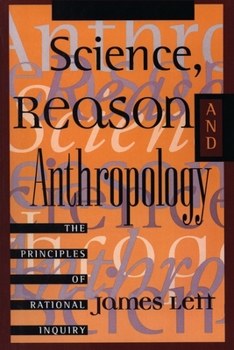
Science, Reason, and Anthropology: A Guide to Critical Thinking


For courses on anthropological theory, history, and methods... Science, Reason, and Anthropology explores the philosophical foundations of anthropology and identifies the fundamental principles of rational inquiry upon which all sound anthropological knowledge is based. As a field guide to critical thinking, with examples throughout, it is devoted to a thorough explication and analysis of the nature of reason and the practice of anthropological inquiry. Chapter one reviews the historical context of the contemporary debate between scientific and humanistic perspectives in anthropology, highlighting essential differences between the two approaches. Chapter two examines the nature of knowledge and explains the essential elements of epistemological analysis. Chapter three describes the basic features of the scientific method; it defines science as an objective, logical, and systematic approach to propositional knowledge, and explains each feature in detail. Chapter four applies the fundamental principles of critical thinking to an analysis of contemporary anthropological theory. Chapter five suggests a reconciliation between the scientific and humanistic approaches, arguing that the essential elements of sound reasoning are common to both perspectives. Science, Reason, and Anthropology argues forcefully for the preeminent value of the scientific approach in anthropology, but it does so while recognizing the inherent worth and innate appeal of the humanistic perspective. Even those who are not predisposed to share the author's conclusions will appreciate the clear and forthright manner with which he presents his arguments.
Format:Paperback
Language:English
ISBN:0847685934
ISBN13:9780847685936
Release Date:November 1997
Publisher:Rowman & Littlefield Publishers
Length:160 Pages
Weight:0.65 lbs.
Dimensions:0.5" x 5.8" x 9.0"
Customer Reviews
2 ratings
A Call for a Scientific Anthropology
Published by Thriftbooks.com User , 18 years ago
This book discusses the epistemological foundations of anthropological theory, including the essential nature of science and anthropological knowledge. Its aim is to identify the means by which anthropological knowledge can best be achieved. For theory, the author understands the set of assumptions underlying the acquisition of knowledge. Thus, the author aims to elucidate the essential principles of rational inquire. About the contents of the book, the author reviews the historical context of the contemporary debate between the scientific and humanistic approaches in anthropology, defining the nature of reason and proposing its logical and moral preeminence in the search for knowledge. He examines the basics of epistemological analysis and the acquisition of reliable knowledge, discussing the general assumptions of science. He then applies the fundamental principles of reason to contemporary anthropological theory, discussing the epistemological limitations of interpretive anthropology. Finally, he analyzes the relationship between science and humanism, identifying what he considers to be some promising approaches in anthropology that apply the fundamental principles of rational inquiry. In a more practical sense, however, the book can be considered mainly a reaction against interpretive anthropology, which he believes to have betrayed its promise towards the search for scientific knowledge, and moving distinctly in the wrong direction. The wrong direction in this case meaning its rejection of the scientific principles of rational inquiry. This is evident because the discussion of interpretive anthropology is a topic that goes on and on throughout the book. The author not only outlines the principles for scientific anthropology, but also seems to build his arguments based on the limitations he identifies in the assumptions and practice of interpretive anthropology. The author defines anthropology as the scientific study of human evolution. He argues that since human evolution has been distinctively a biocultural phenomenon, the discipline of anthropology is necessarily divided into the subfields of archeology, ethnology, linguistics, and biological anthropology. Given this conception, he claims that interpreter ethnographers would be able to evoke and interpret cultural variability and still call themselves anthropologists, as long as they explicitly adhered to the scientific principles of rational inquiry. He opens this possibility as theoretically possible scenario. However, the author goes on to state that interpretive ethnographers are not likely to embrace an anthropology that defines itself as the scientific study of biocultural evolution, because accepting such a definition exposes the comparative triviality of their interests and activities. This last statement is controversial, not only because of its implications to the discipline, but also because of the lack of evidence to make such statement. Promoting one type of topic that an
Excellent resource for learning how to analyze arguments
Published by Thriftbooks.com User , 25 years ago
This book is "about the epistemological foundations of anthropological theory, or the essential nature and ultimate source of anthropological knowledge." It is not "a history of anthropological thought... a catalogue of paradigms... a prospectus for a particular theoretical perspective... or a treatise on research methodology". (p.xiii) Lett's goal is to detail the process of rational inquiry. He is using interpretive anthropology to illustrate his points since he feels it often violates basic principles of rational inquiry. Lett admits he will be using more extreme examples from interpretive anthropology, and not accurately representing it. In the opening chapter, Lett discusses the science vs. non-science debate in anthropology, briefly discussing the origins and goals of interpretive approaches, accusing it of producing irrational arguments. The strength of the book lies in chapters 2 (The Nature of Knowledge) and 3 (The Scientific Approach to Knowledge). In chapter two, Lett discusses the differences between analytical and sythetic propositions, subjective and objective statements, and falsifiability. In chapter 3, Lett presents a detailed definition of science, and outlines methods in which to analyze and evaluate arguments. The remainder (and weaker portion) of the book is devoted to a citique of interpretive anthropology's contributions, and the future of anthropology as a discipline. This is an excellent manual for learning how to construct and evaluate arguments. However, my two problems with the book are: (1) Lett's insistence on evaluating the truth claims of religious beliefs, that science can and should be used to test the claims of religious beliefs. Rather than focus on the function of religion, Lett believes that anthropologists should evaluate religious beliefs in terms of their accuracy. He seems to have a partisan ax to grind, exemplified when disproving the statement "God exists" (p.53), violating his own logical principles that he just outlined. (2) Lett's use of the most rediculous (i.e. Sasquatch example that is constantly used) and extreme examples of interpretive anthropology is weak. Although he himself admits he misrepresents the field in his examples, a more balanced approach could have been taken. It is easy to prove the illogical argumentation of an individual maintaining that Bigfoot is alive and well, running through the Pacific Northwest. Overall, Lett is a clear and concise writer, and has produced a highly readable and useful volume for the study of scientific reasoning in anthropology. Other similar books: Reclaiming a Scientific Anthropology by Lawrence Kuznar
Copyright © 2026 Thriftbooks.com
Terms of Use | Privacy Policy | Do Not Sell/Share My Personal Information | Cookie Policy | Cookie Preferences | Accessibility Statement
ThriftBooks ® and the ThriftBooks ® logo are registered trademarks of Thrift Books Global, LLC
ThriftBooks ® and the ThriftBooks ® logo are registered trademarks of Thrift Books Global, LLC
