
Skip to content
Scan a barcode
Scan
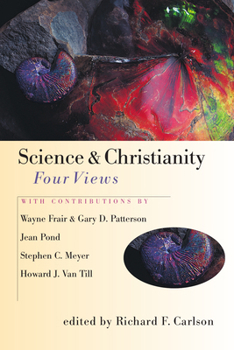
Paperback Science & Christianity: Four Views Book

ISBN: 0830822623

ISBN13: 9780830822621

Science & Christianity: Four Views

Select Format

Select Condition ThriftBooks Help Icon

Recommended

Format: Paperback

Condition: Very Good

$7.99
Save $27.00!
List Price $34.99
Almost Gone, Only 3 Left!
Save to List

Book Overview

Science and Christianity. Are they partners or opponents?

Christians have long debated the relationship of science to faith. With the rise of Darwinism, however, the issue took on new significance. Darwinism appeared to undermine the authority of the Bible and the credibility of Christianity by freeing science of the need for a Creator. Rethinking the relationship between science and Christianity quickly became a priority.

How does a faithful Christian respond to the pronouncements of contemporary science?Is science a help or a hindrance to belief?Are science and the Bible in conflict?

At the beginning of the twenty-first century, Christians continue to wonder whether faithand science are partners or opponents. In this Spectrum Multiview volume six Christian scholars sort through the issues as they present four different views on the relationship of science and Christianity. These include Wayne Frair and Gary D. Patterson for "creationism," Jean Pond for "independence," Stephen C. Meyer for "qualified agreement" and Howard J. Van Till for "partnership."

Each contributor responds to the other scholars, noting points of agreement and disagreement. Editor Richard F. Carlson offers an introduction to this contemporary debate as well as a postscript to help us evaluate the strengths and weaknesses of each view.

Spectrum Multiview Books offer a range of viewpoints on contested topics within Christianity, giving contributors the opportunity to present their position and also respond to others in this dynamic publishing format.

Customer Reviews

3 ratings

Are Science and Religion Separate or Interacting Spheres?

Christians have long debated the relationship of science and faith. With the rise of Darwinism, however, the issue took on new significance. Darwinism appeared to undermine the authority of the Bible and the credibility of Christianity by freeing science of the need for a Creator. Rethinking the relationship between science and Christianity quickly became a priority. How does a faithful Christian respond to the pronouncements of contemporary science? At the beginning of the 21st century, Christians continue to wonder whether faith and science are partners or opponents. In this book six scholars help us sort through the issues as they present four views on the relationship of science and Christianity. These views include creationism, independence, qualified agreement, and partnership. Firstly, Wayne Frair and Gary D. Patterson argue that creationism bolsters faith in the Bible, while basing its claims upon actual scientific evidence. For them, science is the formal study of the observable world while theology is the study of God and his relationship to his created world. They argue that the Bible is to be interpreted as the inerrant word of God, while holding that the actual literal meaning of Genesis could still fit with an ancient age of the universe. Science is seen as supporting what is known by faith. Next, Jean Pond argues for the "independence" viewpoint, like Stephen Jay Gould who argued, "Science and religion are not in conflict, for their teaching occupy distinctly different domains." (pg. 71) Senior Discovery Institute fellow Stephen C. Meyer responds to this view by observing that in reality, science and religion often tread upon the same ground, for "Christianity in particular does not simply address questions of morality and meaning as Gould's NOMA principle asserts, but it also makes factual claims about history, human nature and, it would seem, the origin of the natural world." (pg. 112) Meyer then articulates his view of science and religion, called "qualified agreement." In particular, materialistic theories of origins betray a theistic understanding of the universe. As Bertrand Russell described materialistic science, "Man is the product of causes which had no provision of the end they were achieving" and that predestined him "to extinction in the vast death of the solar system." (pg. 127-128) Meyer argues that history demonstrates that many proponents of materialistic science have viewed science as antithetical to faith. According to Meyer, new scientific developments including Big Bang cosmology, fine-tuning arguments, and information in DNA support design in the universe and theistic perspectives of reality. Finally, Howard J. Van Till argues for acceptance of evolutionary science. Van Till puts particular emphasis upon what he calls "transparently shoddy scholarship" against evolution coming from the Christian community which is an "embarrassment." (pg. 196). Van Till views opposition to evolution as e

Great views!!

This book is exciting as well as informative. Steve Meyer's essay is extraordinary! Great info! I can't wait to read it again!!

A very helpful dialogue...whatever your view.

While we stand firmly in the "creationist" camp, all of the contributors are worth reading here -- and Editor Richard Carlson provides invaluable help as "moderator." If you are dealing with these issues -- get this new book! Recommended. -- The Discerning Reader
Copyright © 2026 Thriftbooks.com Terms of Use | Privacy Policy | Do Not Sell/Share My Personal Information | Cookie Policy | Cookie Preferences | Accessibility Statement
ThriftBooks ® and the ThriftBooks ® logo are registered trademarks of Thrift Books Global, LLC

GoDaddy Verified and Secured