


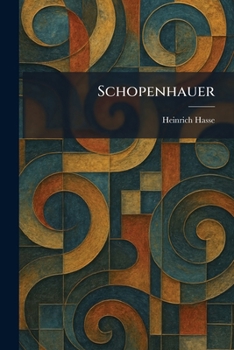
Schopenhauer

Select Format
Select Condition 
Book Overview
"Schopenhauer" by Heinrich Hasse offers a profound exploration into the life and intellectual legacy of Arthur Schopenhauer, one of the most influential figures in nineteenth-century philosophy. This comprehensive study examines the core tenets of Schopenhauer's thought, most notably his masterwork, "The World as Will and Representation". Hasse meticulously traces the development of Schopenhauer's metaphysical system, exploring his unique blend of Western rationalism and Eastern spiritual insights.
The work delves into the philosopher's concept of the "Will"-a blind, insatiable force driving all existence-and the resulting pessimistic outlook that defined his worldview. Beyond abstract theory, Hasse situates Schopenhauer within the broader context of German Idealism, illustrating his reactions to contemporaries like Hegel and Kant. Readers will gain insight into how Schopenhauer's aesthetics, ethics, and views on human suffering influenced later thinkers, including Nietzsche and Freud. This volume serves as an essential resource for those seeking to understand the enduring impact of a philosopher who challenged the optimism of his age and redefined the boundaries of human perception and desire.
This work has been selected by scholars as being culturally important, and is part of the knowledge base of civilization as we know it. This work was reproduced from the original artifact, and remains as true to the original work as possible. Therefore, you may see the original copyright references, library stamps (as most of these works have been housed in our most important libraries around the world), and other notations in the work.
This work is in the public domain in the United States of America, and possibly other nations. Within the United States, you may freely copy and distribute this work, as no entity (individual or corporate) has a copyright on the body of the work.
As a reproduction of a historical artifact, this work may contain missing or blurred pages, poor pictures, errant marks, etc. Scholars believe, and we concur, that this work is important enough to be preserved, reproduced, and made generally available to the public. We appreciate your support of the preservation process, and thank you for being an important part of keeping this knowledge alive and relevant.
Customer Reviews
ThriftBooks ® and the ThriftBooks ® logo are registered trademarks of Thrift Books Global, LLC
