


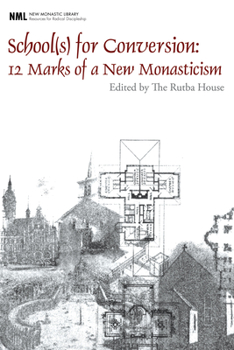
School(s) for Conversion

Select Format
Select Condition 
Book Overview
Throughout the history of the church, monastic movements have emerged to explore new ways of life in the abandoned places of society. School(s) for Conversion is a communal attempt to discern the marks of a new monasticism in the inner-cities and forgotten landscapes of the Empire that is called America.
Format:Paperback
Language:English
ISBN:1597520551
ISBN13:9781597520553
Release Date:January 2005
Publisher:Cascade Books
Length:190 Pages
Weight:0.66 lbs.
Dimensions:0.5" x 6.1" x 9.0"
Customer Reviews
1 rating
An ancient breeze...
Published by Thriftbooks.com User , 20 years ago
An ancient breeze is beginning to blow in unexpected places in North America. While monastic spirituality and institutions have been part of the Catholic and Eastern Orthodox communions for centuries, some North American Protestants are beginning to explore this approach to spirituality and community. Inspired by traditional monastic forms and disciplines as well as some Anabaptist traditions, proponents of a "new monasticism" advocate a turn, at least in part, to the kinds of "intentional community" seldom seen in American Protestant churches. Jonathan R. Wilson coined the term "new monasticism" in his short monograph, Living Faithfully In a Fragmented World. Drawing on the social analysis of Alasdair MacIntyre (After Virtue) and the writings of Dietrich Bonhoeffer (Life Together and Letters and Papers From Prison), Wilson called for a "new monasticism ... that will sustain the [church's] witness to the gospel of Jesus Christ through faithful living." (Living Faithfully, p. 69) This call assumes that the contemporary church is so compromised by its identification with and embrace of the forces and institutions of modernity and empire, that disentanglement from these forces and institutions is necessary for the church to recover its identity and mission. In June 2004, the Rutba House ("a Christian community of hospitality, peacemaking, and discipleship" in Durham, N.C.) invited representatives from various neo-monastic communities across the country to a conference designed to "discern a possible shape of a new monasticism." School(s) for Conversion: 12 Marks of a New Monasticism is one result of this meeting. Participants in the conference identified twelve "marks" or common characteristics of these neo-monastic communities. These marks include: sharing economic resources with fellow community members and the needy, hospitality to the stranger, lament for racial divisions within the church and our communities combined with the active pursuit of a just reconciliation, geographical proximity to community members who share a common rule of life, and peacemaking in the midst of violence and conflict resolution along the lines of Matthew 18. Edited by the Rutba House, School(s) for Conversion contains an eloquent introduction by Wilson and one essay, written by various conference participants, on each of the twelve marks. Essay contributors include members of The Simple Way and New Jerusalem Now recovery center in Philadelphia; Reba Place Fellowship in Evanston, Illinois; and Communality in Lexington, Kentucky. The essays are generally well written and offer a helpful balance of theory and practice. Many Christians in "the last remaining superpower" believe that the church in America is in need of deep renewal and reform. The forces of empire: capitalism, militarism, consumerism, individualism and pursuit of the "American dream" have taken us far from our common life with Christian brothers and sisters in service to and for the Kingdom of Go
Copyright © 2026 Thriftbooks.com
Terms of Use | Privacy Policy | Do Not Sell/Share My Personal Information | Cookie Policy | Cookie Preferences | Accessibility Statement
ThriftBooks ® and the ThriftBooks ® logo are registered trademarks of Thrift Books Global, LLC
ThriftBooks ® and the ThriftBooks ® logo are registered trademarks of Thrift Books Global, LLC
