


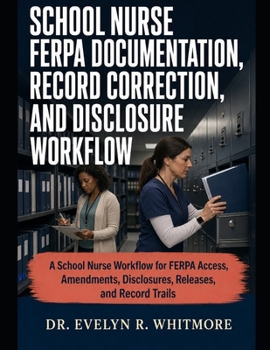
School Nurse FERPA Documentation, Record Correction, and Disclosure Workflow

A Practical Operating System
school health-record privacy is presented as a field-ready operating system. School Nurse FERPA Documentation, Record Correction, and Disclosure Workflow turns a recurring, high-stakes problem into visible stages, named decision rights, evidence checkpoints, escalation routes, and reusable records.
Who This Book Is For
The book is designed for school nurses, records custodians, principals, district privacy officers, and student-support teams. It assumes readers are responsible for real work, real handoffs, and real consequences, but it does not assume that every organization already has a shared vocabulary, a reliable queue, or a defensible way to show what happened. Examples are fictional composites and tools should be localized.
The Core Workflow
The operating model moves from intake and boundary-setting to verification, decision, action, escalation, documentation, review, and improvement. It makes hidden work visible: who owns the next step, what evidence is sufficient, which requests require a pause, what can be delegated, and when a matter must move to an authorized leader, counsel, specialist, or governing body.
What You Will Build
Readers work through record creation, objective charting, parent and eligible-student access, amendment requests, internal need-to-know review, written consent, emergency and legal requests, disclosure logs, transfer, retention, and annual governance. Each chapter connects explanation to a practical artifact so the reader leaves with more than principles. The tools are designed for local policy, training, quality improvement, audit preparation, or leadership reporting, with owners, review intervals, exception routes, and source control built into the operating logic.
Templates and Decision Support
The toolkit includes record-lifecycle maps, access checklists, amendment decision tools, consent and release checklists, emergency-disclosure decision trees, disclosure logs, escalation scripts, and reproducible templates. These tools are specific about inputs, outputs, timing, escalation, and evidence. They can support orientation, daily huddles, case review, committee work, quality improvement, audit preparation, or reporting. They do not replace professional judgment; they help teams apply judgment in a way that is explainable, repeatable, and easier to improve.
From First Use to Sustainment
Implementation is staged. Start by mapping the current state, naming local decision-makers, and identifying the source that controls each rule. Test a small number of cases, calibrate the people who will use the tools, define stop rules, and measure fidelity before declaring success. Then maintain the system through dashboards, review cadence, training, change control, and lessons learned.
What This Book Does Not Promise
This is educational workflow guidance, not legal, medical, billing, employment, or regulatory advice. Laws, regulations, payer policies, clinical guidance, technology behavior, and organizational requirements change. Readers must verify current requirements against the official sources named in the book and their own authorized policies and professionals.
A Better Way to Run the Work
When work is complex, failure is often an invisible process with unclear ownership, weak evidence, and no reliable feedback loop. This manual gives teams a shared way to see the work, make safer decisions, communicate status, and learn from exceptions.
In Practice
The framework keeps attention on the next safe action, the next evidence check, and the next review point. Its cumulative sequence connects definitions, records, boundaries, and decision rules so the reader can use the book both as an implementation guide and as a reference during recurring cases.
Customer Reviews
ThriftBooks ® and the ThriftBooks ® logo are registered trademarks of Thrift Books Global, LLC
