


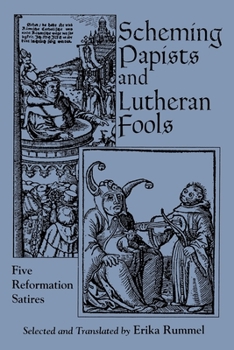
Scheming Papists and Lutheran Fools: Five Reformation Satires


Select Format
Select Condition 
Book Overview
This volume is a collection of five satires from the Reformation period, written between 1517 and 1526. In her Introduction to the work, Rummel explains that the battle between reformers and champions of the old faith was waged on many fronts, not only by preachers thundering from the pulpits, theologians facing each other in acrimonious disputations, and church authorities issuing censures and condemnations. This collection focuses on the impact and importance of a supporting cast of satirists whose ad hoc productions reached a wider audience, in a more visceral manner, than the rational approach which typified scholarly theological arguments. Rummel explains: Satire, a genre that requires finely honed language skills, was the preferred weapon of the humanists, who by and large sympathizes with the reformers. The humanists and reformers were often so closely associated in the reading public's mind that the earliest phase of the Reformation was sometimes interpreted as a quarrel between philogists and theologians, a manifestation of professional jealousies. Thus Erasmus claimed that the debates of his time were the result of antagonism between the faculties of Arts and Theology.
Three of the selections contained in the volume represent the Reformers, and two support the Catholics, the Papists of the title. These satirical essays, circulated widely among educated laypersons, use wit and biting humor to ridicule and discredit their adversaries and belong to a genre which was part of a larger body of sixteenth-century satire. The proliferation of satires became a concern of authorities who moved to suppress what they called hate-mongering. Officials banned the publication of anonymously authored writings, effectively ending the publication of the satires, which were largely published either anonymously or carried only the name of the publisher. As a result, many of the pieces did not survive to the present day, many more are only known to us through obscure references in other literature. This volume brings to light five of these satiric pieces, written in the pivotal period when the Reformation ceased to be a protest and organized itself as a full-fledged movement. The topical issues featured in each satire are brought into historical context by a headnote explaining the circumstances surrounding its publication and giving bibliographical information about the satire's author. The witty style makes this collection entertaining reading and the impact of these writings sheds new light on the history of the Reformation.Related Subjects
16th Century Ancient & Classical Literature Christian Books & Bibles Church History Greek History Humor Humor & Entertainment Literary Criticism Literary Criticism & Collections Literature & Fiction Medieval Modern (16th-21st Centuries) Movements & Periods Religion Religion & Spirituality Religious StudiesCustomer Reviews
Excellent book, hardly any flaws
ThriftBooks® and the ThriftBooks® logo are registered trademarks of Thrift Books Global, LLC
