


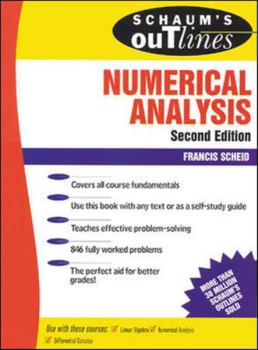
Schaum's Outline of Numerical Analysis


Select Format
Select Condition 
Book Overview
If you want top grades and thorough understanding of numerical analysis, this powerful study tool is the best tutor you can have It takes you step-by-step through the subject and gives you accompanying related problems with fully worked solutions. You also get additional problems to solve on your own, working at your own speed. (Answers at the back show you how you re doing.) Famous for their clarity, wealth of illustrations and examples and lack of dreary minutiae Schaum s Outlines have sold more than 30 million copies worldwide. This guide will show you why "
Format:Paperback
Language:English
ISBN:0070552215
ISBN13:9780070552210
Release Date:January 1989
Publisher:McGraw-Hill Companies
Length:480 Pages
Weight:1.92 lbs.
Dimensions:0.8" x 8.2" x 10.9"
Customer Reviews
4 ratings
Predates the computer age but a LOT of fun!
Published by Thriftbooks.com User , 16 years ago
This isn't a good book on how to do numerical analysis on a computer. It's more about the methods that people used to use when they did numerical analysis with pencil and paper. This book goes into a lot of depth into how interpolation equations are derived, and into the calculus of finite differences. Personally I think that's a beautiful subject and a lot of fun, be it useful or not - that's what math is for math's sake. I worked all of the problems in this book when I was in high school and I recognized many of the tricks when I took a combinatorics class years later.
A book with an audience
Published by Thriftbooks.com User , 18 years ago
With no previous background in numerical analysis, I bought this book on the recommendation of my boss who loved the first edition. I had also ordered a whole lot of other books (many from Dover editions). It turns out this is the one I love to pick up from time to time so as to learn a new idea. It goes straight to the point and gives your mind something to munch on. I suppose that with time I'll be completing with some of my other books, to look for the rigorous proofs and so on, but for the time being this book is preparing me.
Excellent Solutions Book for Fast Answers!
Published by Thriftbooks.com User , 19 years ago
I've had this outline for years. My only complaint about Schaum's is that sometimes their answers are not in enough detail and their indexes are skimpy. Outlines live and die based on their detailed solutions to solved problems and their index. This particular outline is excellent. All the basic numerical methods are presented with the standard format: theory, solved problems, problems with answers. What could be added, either here, or in future text (separate) would be an optimization methods section: differential search, Hooke & Jeeves min./max. search and the Golden Mean search. The later, especially, is easy to program into Excel so it would useful to show the pitfalls in these methods. All in all, this is a text you want in your engineering collection for those problems that require detailed analysis. If this review was useful, please say so.
useful revision of many numerical methods
Published by Thriftbooks.com User , 21 years ago
Scheid gives us a broad range of methods in numerical analysis. The 846 problems can certainly keep you busy. Plus, the book is also useful as a concise summary of the most common and useful methods in the field. Students of maths, physical sciences and engineering should already be familiar with several of the methods. Like performing numerical integration or differentiation, because these mathematical steps are the fundamental calculus operations, and those fields all use these. So too is finding roots of equations, and for this, there is a chapter on Newton's method. Which tends to assume that you have an analytic form for the function and for its derivative, where you want the roots of the function. The book also supports statistics. Unsurprisingly, since statistics is inherently about numerical evaluations. So we have least squares methods of curve fitting, and Monte Carlo methods, where the latter can also be used for numerical integration. Ironically, while the Monte Carlo is described, the book is somewhat weak on methods for generating random numbers. And how to measure the "randomness" of such algorithms. For this, I suggest you turn to "The Art of Computer Programming" by Donald Knuth. He has an excellent length discussion on the subject. Curve fitting is also discussed in a chapter on splines. You may already be acquainted with these, in the context of graphics packages which can fit B splines to data points.
Copyright © 2026 Thriftbooks.com Terms of Use
| Privacy Policy | Do Not
Sell/Share My Personal Information | Cookie Policy | Cookie Preferences | Accessibility Statement
ThriftBooks® and the ThriftBooks® logo are registered trademarks of Thrift Books Global, LLC
ThriftBooks® and the ThriftBooks® logo are registered trademarks of Thrift Books Global, LLC
