


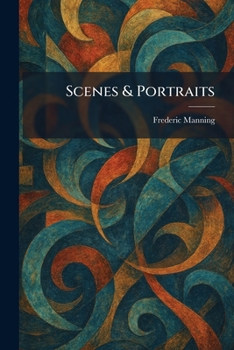
Scenes & Portraits

"Scenes & Portraits" is a sophisticated collection of philosophical and historical sketches that explore the evolution of human thought and faith. Through a series of carefully crafted dialogues and narratives set in diverse eras-ranging from the intellectual landscape of ancient Athens to the religious complexities of the Renaissance-Frederic Manning examines the persistent tensions between skepticism and belief. Each chapter serves as a window into a different epoch, featuring both historical figures and fictional voices who engage in profound meditations on the nature of the soul and the human condition.
Manning's prose is noted for its elegance, erudition, and atmospheric depth, transforming abstract philosophical inquiries into vivid, dramatized encounters. By situating his characters in moments of historical transition, he highlights the recurring dilemmas that have shaped Western civilization. "Scenes & Portraits" stands as a significant work of early 20th-century literature, offering readers a contemplative and deeply learned journey through the history of ideas. It remains an essential read for those interested in the intersection of literature, history, and the perennial search for meaning.
This work has been selected by scholars as being culturally important, and is part of the knowledge base of civilization as we know it. This work was reproduced from the original artifact, and remains as true to the original work as possible. Therefore, you may see the original copyright references, library stamps (as most of these works have been housed in our most important libraries around the world), and other notations in the work.
This work is in the public domain in the United States of America, and possibly other nations. Within the United States, you may freely copy and distribute this work, as no entity (individual or corporate) has a copyright on the body of the work.
As a reproduction of a historical artifact, this work may contain missing or blurred pages, poor pictures, errant marks, etc. Scholars believe, and we concur, that this work is important enough to be preserved, reproduced, and made generally available to the public. We appreciate your support of the preservation process, and thank you for being an important part of keeping this knowledge alive and relevant.
Customer Reviews
ThriftBooks ® and the ThriftBooks ® logo are registered trademarks of Thrift Books Global, LLC
