


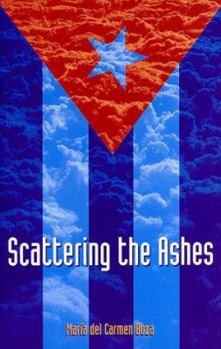
Scattering the Ashes


"Scattering The Ashes" is a book about exile, about Cuba and her offspring, and about the power of history and politics over Cubans'daily lives. Maria del Carmen Boza tells that shared history through... This description may be from another edition of this product.
Format:Paperback
Language:English
ISBN:0927534754
ISBN13:9780927534758
Release Date:May 1998
Publisher:Bilingual Review Press (AZ)
Length:387 Pages
Weight:1.20 lbs.
Dimensions:1.2" x 5.5" x 8.5"
Customer Reviews
4 ratings
A compelling memoir
Published by Thriftbooks.com User , 19 years ago
I recently returned from Cuba, and it has been quite difficult for me to reconcile the bitterness of Cuban Americans with the beauty of the island. I have been reading a lot of Cuban American memoirs from the 1.5 generation recently, and Maria Del Carmen Boza is the first author who I have seen to set aside her anger over losing her homeland with the Revolution and creating a real portrait of Cuba in the 1950's. A beautiful piece of literature, I highly recommend this book. Also recommended, Three Trapped Tigers, The Fourteen Sisters of Emilio Montez O'Brien, the Moon Guide to Cuba
Scattering the Ashes
Published by Thriftbooks.com User , 25 years ago
Reading about the betrayal by the Kennedy administration of the invasion by Brigade 2506 was one of the first topics that shaped my view of things. It may have been in "None Dare Call It Treason" which I read in 1964. In any event, it made a great impression on me as a twelve-year-old boy. In the same time period, I was reading "Reminiscences" the autobiography of Gen. Douglas MacArthur and "Conscience of a Conservative" by Sen. Barry Morris Goldwater. Reading details of Giron in Maria's book, details which were unavailable in 1964, brought back all of the personal anguish which I felt at the time and somehow it was a reassurance that the frustration and anguish which I have held close to my heart all of these years was a validation; a validation of my own life.The failure to defeat Castro by actually supporting actions like Brigade 2506 has been the most disastrous blunder in American history. Certainly, I think that it ranks as first place as the damage that Castro has inflicted upon the world as a Soviet client state has had the most direct impact upon my country. The betrayal of Chiang Kai-Shek and the Alger Hiss conspiracy with Joseph Stalin at Yalta would rank second and third. Every time I view something by the CBS news department, it reminds me that I'm in "internal exile" in my own country.I have a great respect for Maria del Carmen Boza for writing about her family in such a close personal way as it exposes her private life to the public. To bring all of their vastitudes and personal strengths and weaknesses to public view gives me a greater appreciation of myself and the value of life itself. For this gift I can only say "thank you."
A moving story about reconciliation with the past
Published by Thriftbooks.com User , 27 years ago
The act of emigration is traumatic for most of us, who retain the freedom to return to our homelands, to visit family and friends, to find the comfort of familiar sights and sounds. In Ms. Boza's memoir, a fragile young girl emigrates to this country as an exile who can never see her extended family or home again. She writes a poignant and thought-provoking story about her struggle to make peace with her past and move on with her life. While this book is not eary to read, it is beautifully written and worth the effort. I'm still thinking about it.
A courageous book -- difficult and rewarding.
Published by Thriftbooks.com User , 27 years ago
Think of Cuban exiles and you will likely come up with a stereotypical figure -- rich, right-wing, insane. In the US this prejudice is largely unexamined. Cuban exiles are easy to dismiss. But I wouldn't dismiss this one.Boza, a Cuban exile who came to the US when she was eight, has written a courageous book -- her first. Compelled to discover why her father committed suicide -- she explores the effect of the political on the personal within her own family, and within the exile community.Boza writes compellingly about this life in exile, a life sometimes warped by memories of the old and the realities of the new. Her father was a player in Cuban exile politics, and was consumed with this, becoming more and more bitter after the Bay of Pigs fiasco. Yet he is sympathetic, and Boza is successful in writing honestly of an imperfect man in a way that makes his obsession understandable if not troubling.But this memoir is not just about her father. It explores how, after coming to Miami, life in exile unravelled, how personal things, and connections with the commonplace - birthdays, clothes, food -, became more and more of an abstraction. And she writes about her own struggles to make her own world concrete again.It is a difficult book in some ways. Boza moves against the grain. Her narrative skips in time. At times the narrative intrudes on our own sense of privacy making us a little uncomfortable. She often interrupts the narrative, disrupting the political with the personal or vice versa, taking long detours around the subject. Memory intrudes - some pleasant, some ugly. We look at it all. But the writing is strong throughout, and there are numerous long sections that are poetic if not sublime.Life in exile, in spite of the ease with which we can imagine it, must have been/must be strange and isolating. Much more so for an eight-eighteen year old to watch ones parents slip into a kind of madness. There are no heroes in this book. But it took a lot of courage to write.
Copyright © 2026 Thriftbooks.com Terms of Use
| Privacy Policy | Do Not
Sell/Share My Personal Information | Cookie Policy | Cookie Preferences | Accessibility Statement
ThriftBooks® and the ThriftBooks® logo are registered trademarks of Thrift Books Global, LLC
ThriftBooks® and the ThriftBooks® logo are registered trademarks of Thrift Books Global, LLC
