


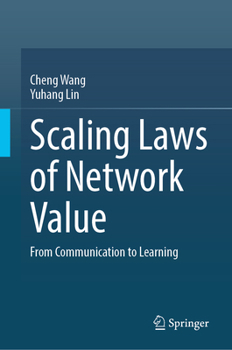
Scaling Laws of Network Value: From Communication to Learning
No Customer Reviews

This book bridges two seemingly distinct worlds--network theory and machine learning--to reveal the universal laws of scalability that underlie both. It examines how value, capacity, and performance evolve as systems expand, offering a unified framework that connects Metcalfe's Law with neural scaling laws. By comparing network growth and model scaling, the book uncovers striking parallels: the diminishing throughput of densely connected networks mirrors the saturation of model generalization in large AI systems. Through rigorous analytical models, it explains when performance scales sublinearly, linearly, or even superlinearly--and why these transitions matter for the future of communication infrastructure and intelligent computation. Designed for researchers and advanced practitioners in computer networks, information theory, and artificial intelligence, this work delivers both conceptual insight and practical guidance. It helps readers recognize the structural forces that shape scalability, the mathematical trade-offs between capacity and efficiency, and the design principles that can transfer between large-scale networks and learning systems. Readers with backgrounds in probability, linear algebra, and algorithmic modeling will find this book a compelling synthesis of theory and application--a guide to understanding how scaling behavior defines the limits and possibilities of modern computational systems.
Format:Hardcover
Language:English
ISBN:9819581095
ISBN13:9789819581092
Release Date:July 2026
Publisher:Springer
Customer Reviews
0 rating
Copyright © 2026 Thriftbooks.com Terms of Use
| Privacy Policy | Do Not
Sell/Share My Personal Information | Cookie Policy | Cookie Preferences | Accessibility Statement
ThriftBooks® and the ThriftBooks® logo are registered trademarks of Thrift Books Global, LLC
ThriftBooks® and the ThriftBooks® logo are registered trademarks of Thrift Books Global, LLC
