


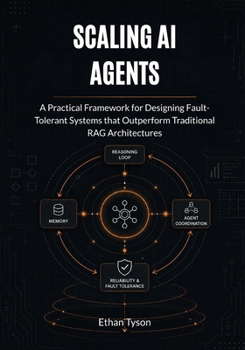
Scaling AI Agents: A Practical Framework for Designing Fault-Tolerant Systems that Outperform Traditional RAG Architectures

Traditional RAG helped teams ground AI responses, but it was never built to plan, act, recover, coordinate tools, or survive real-world production failures. If your AI system still stops at retrieval and summarization, it may already be hitting the ceiling that modern enterprise workloads are pushing beyond.
Scaling AI Agents gives engineers, architects, and technical leaders a practical framework for building production-grade agentic systems that reason through goals, call tools safely, manage memory, coordinate workflows, and recover when infrastructure breaks. Instead of treating agents as mysterious black boxes, this book frames them as reliable software systems that need architecture, observability, evaluation, security, and operational control.
Inside, readers will learn how to design AI agents that move beyond static RAG pipelines into fault-tolerant, action-oriented systems. The book covers single-agent reasoning loops, ReAct patterns, structured outputs with Pydantic, Model Context Protocol integrations, multi-agent orchestration, durable execution with Temporal, memory systems, guardrails, evaluation pipelines, cloud deployment, and cost controls.
You will gain practical insight into:
Building agents that can reason, act, verify, and recoverDesigning secure tool-calling systems with clear approval gatesManaging context, memory, latency, and token costsEvaluating agents by goal completion, not just response qualityDeploying observable, fault-tolerant agentic microservicesKnowing when to use multi-agent systems and when to keep the architecture simpleFor developers ready to move from AI prototypes to resilient autonomous systems, Scaling AI Agents is a hands-on guide to building agents that do real work reliably.
Customer Reviews
ThriftBooks ® and the ThriftBooks ® logo are registered trademarks of Thrift Books Global, LLC
