


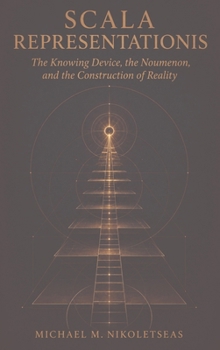
Scala Representationis

What is knowledge if the world is never simply copied into the mind?
SCALA REPRESENTATIONIS: The Knowing Device, the Nooumenon, and the Construction of Reality develops a systematic theory of representation from primitive biological beginnings to language, science, self-reference, and artificial intelligence.
Its central proposition is concise: The world constrains; the knowing device fabricates.
Knowing does not begin with a finished object entering consciousness. It begins when a physical system is altered by its encounter with physis. From this alteration emerges what Michael M. Nikoletseas calls the primitive nooumenon: an internally fabricated state produced under external constraint. From there, the book reconstructs a scala through substitution, equivalence, abstraction, phenomenal organization, naming, conceptual thought, scientific formalization, and the representation of the self.
The argument rejects two familiar extremes. Against naive realism, it denies that the knower simply receives an unmediated copy of reality. Against radical constructivism, it insists that representation is never free invention: the world remains independent of the device and constrains what representations can succeed.
This leads to a distinctive account of knowledge. Knowledge is not possession of reality and does not require identity between representation and what is represented. It consists instead in reproducible structural concordance: the preservation of relations across transformations, instruments, observers, experiments, and representational systems.
Science acquires a precise epistemological role. Measurement, experiment, statistics, replication, mathematics, and formal modeling are not escapes from representation. They force representations back into contact with the resistant organization of the world. Science becomes corrective representation: a disciplined system for exposing error and strengthening relations that survive independent transformation.
The book places classical philosophy within this genealogy. Heraclitus is read through logos, measure, relation, and semainein, as a critic of ordinary naming. Parmenides is approached through semata, necessity, continuity, and disciplined noein. Kant enters after the biological genealogy of the knowing device has been reconstructed, allowing the problem of the noumenon to be reconsidered in relation to receptor limits, neural organization, language, and evolved modes of cognition.
The later chapters extend the scala into self-reference and artificial intelligence. The knowing device becomes one of its own objects. The first-person "I" is examined as a representational achievement rather than evidence of an inner metaphysical spectator. Artificial systems introduce a second genealogy in which human signs become constraints of another device, raising questions about self-modeling, agency, language, and machine-generated first-person discourse.
The resulting epistemology is realist without being absolutist and fallibilist without becoming skeptical. Reality is independent of the knower, but access to it is mediated through physical devices, biological histories, instruments, languages, and formal systems. Mediation does not make knowledge impossible; it makes correction necessary.
SCALA REPRESENTATIONIS brings neuroscience, Presocratic philosophy, Kantian questions, scientific methodology, statistics, and artificial intelligence into a single architecture of representation. It asks not how representation can be escaped, but what knowledge can legitimately be within it.
Customer Reviews
ThriftBooks ® and the ThriftBooks ® logo are registered trademarks of Thrift Books Global, LLC
