


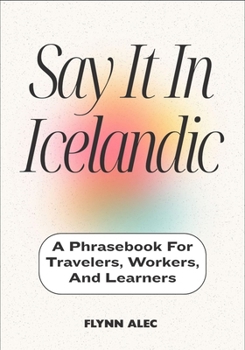
Say It In Icelandic: A Phrasebook For Travelers, Workers, And Learners
No Customer Reviews

The majority of Icelandic speakers use the North Germanic language known as Icelandic ( slenska). It is one of the most traditional Scandinavian languages because it has kept a lot of the vocabulary and grammar of Old Norse. Icelandic as it is today is remarkably inflected and unaffected by foreign linguistic influences, in contrast to its Nordic relatives, such as Danish, Norwegian, and Swedish.
Linguistic Roots and History:
- Icelandic originated from Old Norse, the language of the Vikings, who settled in Iceland around the 9th century. While other Scandinavian languages have undergone significant simplification, Icelandic has preserved many archaic features, including case endings and complex verb conjugations.
Alphabet and Pronunciation:
- The Icelandic alphabet consists of 32 letters, including unique characters like (thorn) and (eth), which represent sounds no longer found in most other Germanic languages. Pronunciation can be challenging for beginners due to vowel shifts and consonant clusters.
Grammar Overview:
Icelandic grammar is complex, featuring: Four noun cases (nominative, accusative, dative, genitive)Three grammatical genders (masculine, feminine, neuter)Strong and weak verb conjugationsDefinite and indefinite article endings instead of separate wordsVocabulary and Loanwords:
Icelandic maintains a strict policy of linguistic purity, creating new words from native roots instead of borrowing foreign terms. For example: T lva (computer) - a combination of tala (number) and v lva (prophetess)S mi (telephone) - derived from an Old Norse word for "thread"Modern Usage and Preservation:
- Spoken by around 350,000 people, Icelandic is the official language of Iceland and is actively preserved through institutions like the rni Magn sson Institute for Icelandic Studies. Despite globalization, Icelanders take great pride in their language, ensuring its continuity through strict education policies and language reforms.
Learning Icelandic:
- For learners, Icelandic can be challenging but rewarding. Mastery of pronunciation, case system, and verb conjugation is essential. However, due to Iceland's small population and emphasis on language preservation, resources such as online courses, textbooks, and language apps are readily available.
Linguistic Roots and History:
- Icelandic originated from Old Norse, the language of the Vikings, who settled in Iceland around the 9th century. While other Scandinavian languages have undergone significant simplification, Icelandic has preserved many archaic features, including case endings and complex verb conjugations.
Alphabet and Pronunciation:
- The Icelandic alphabet consists of 32 letters, including unique characters like (thorn) and (eth), which represent sounds no longer found in most other Germanic languages. Pronunciation can be challenging for beginners due to vowel shifts and consonant clusters.
Grammar Overview:
Icelandic grammar is complex, featuring: Four noun cases (nominative, accusative, dative, genitive)Three grammatical genders (masculine, feminine, neuter)Strong and weak verb conjugationsDefinite and indefinite article endings instead of separate wordsVocabulary and Loanwords:
Icelandic maintains a strict policy of linguistic purity, creating new words from native roots instead of borrowing foreign terms. For example: T lva (computer) - a combination of tala (number) and v lva (prophetess)S mi (telephone) - derived from an Old Norse word for "thread"Modern Usage and Preservation:
- Spoken by around 350,000 people, Icelandic is the official language of Iceland and is actively preserved through institutions like the rni Magn sson Institute for Icelandic Studies. Despite globalization, Icelanders take great pride in their language, ensuring its continuity through strict education policies and language reforms.
Learning Icelandic:
- For learners, Icelandic can be challenging but rewarding. Mastery of pronunciation, case system, and verb conjugation is essential. However, due to Iceland's small population and emphasis on language preservation, resources such as online courses, textbooks, and language apps are readily available.
Format:Paperback
Language:English
ISBN:B0FLVM1RN1
ISBN13:9798296967077
Release Date:August 2025
Publisher:Independently Published
Length:98 Pages
Weight:0.41 lbs.
Dimensions:0.2" x 7.0" x 10.0"
Related Subjects
HistoryCustomer Reviews
0 rating
Copyright © 2026 Thriftbooks.com
Terms of Use | Privacy Policy | Do Not Sell/Share My Personal Information | Cookie Policy | Cookie Preferences | Accessibility Statement
ThriftBooks ® and the ThriftBooks ® logo are registered trademarks of Thrift Books Global, LLC
ThriftBooks ® and the ThriftBooks ® logo are registered trademarks of Thrift Books Global, LLC
