


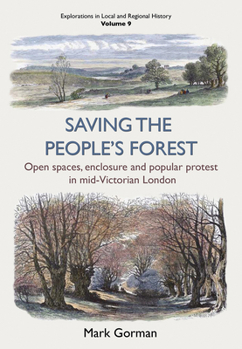
Saving the People's Forest: Open Spaces, Enclosure and Popular Protest in Mid-Victorian London Volume 9
No Customer Reviews

The growth of 19th-century London was unprecedented, swallowing up villages, commons and open fields around the metropolitan fringe in largely uncontrolled housing development. In the mid-Victorian period opposition to this unbridled growth coalesced into a movement that campaigned to preserve the London commons. The history of this campaign is usually presented as having been fought by members of the metropolitan upper middle class, who played out their battles mainly in parliament and the law courts. In this fascinating book Mark Gorman tells a different story - of the key role played by popular protest to preserve Epping Forest and other open spaces in and near London. He shows how throughout the 19th century such places were venues for both radical politics and popular leisure, helping to create a sense of public right of access, even 'ownership'. London's suburban growth was partly a response to the rising aspirations of an artisan and lower middle class who increasingly wanted direct access to open space. This created the conditions for the mid-Victorian commons preservation movement, and also gave impetus to distinctive popular protest by proletarian Londoners.
Format:Paperback
Language:English
ISBN:1912260417
ISBN13:9781912260416
Release Date:June 2021
Publisher:University of Hertfordshire Press
Length:256 Pages
Weight:0.85 lbs.
Dimensions:0.4" x 6.7" x 9.5"
Customer Reviews
0 rating
Copyright © 2026 Thriftbooks.com
Terms of Use | Privacy Policy | Do Not Sell/Share My Personal Information | Cookie Notice | Cookie Preferences | Accessibility Statement
ThriftBooks ® and the ThriftBooks ® logo are registered trademarks of Thrift Books Global, LLC
ThriftBooks ® and the ThriftBooks ® logo are registered trademarks of Thrift Books Global, LLC
