


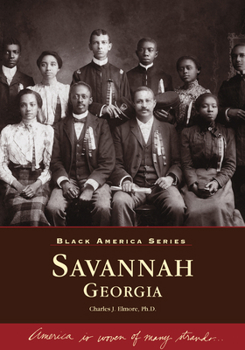
Savannah, Georgia

Select Format
Select Condition 
Book Overview
Pioneering African-American families, spanning generations from slavery to freedom, enrich Savannah's collective history. Men and women such as Andrew Bryan, founder of the nation's oldest continuous black Baptist church; the Rev. Ralph Mark Gilbert, who revitalized the NAACP in Savannah; and Rebecca Stiles Taylor, founder of the Federation of Colored Women Club, are among those lauded in this retrospective. Savannah's black residents have made immeasurable contributions to the city and are duly celebrated and remembered in this volume.
Format:Paperback
Language:English
ISBN:073851408X
ISBN13:9780738514086
Release Date:February 2002
Publisher:Arcadia Publishing (SC)
Length:128 Pages
Weight:0.70 lbs.
Dimensions:0.4" x 6.5" x 9.2"
Customer Reviews
2 ratings
Excellent source of information on blacks in Savannah's history
Published by Thriftbooks.com User , 18 years ago
I'm working on a mystery series that is set in Savannah and this book helped me understand the history of African Americans in Savannah. I got to 'meet' some of the black founding families. The photographs are marvelous. I love doing research for my projects and this book was very helpful by giving me a sense of place where Savannah is concerned.
writer, columnist
Published by Thriftbooks.com User , 22 years ago
This book opens the door to an unexplored and fascinating room in Savannah history, a room full of rich memories and engaging stories of how African Americans have shaped one of America?s oldest cities. Author Charles Elmore has left no stone unturned as he rummaged through dusty scrapbooks and the minds of their owners to give voice to hundreds of Savannah?s unsung black trailblazers.Well-written and profusely illustrated, this book fills a gaping hole in the city?s history. The role that blacks have played in shaping that history isn?t widely understood and appreciated by the general public. One of the main reasons for this lack of familiarity is the absence of engaging works like this one. Readers need not have any personal ties to Savannah to enjoy this work. These readers will hear in some of Savannah?s local history echoes of complex national issues with which all Americans continue to grapple. The notion of giving blacks 40 acres and a mule as compensation for their enslavement, for example, had its roots in Savannah. Moreover, an incident that inspired one of John Greenleaf Whittier?s poems grew out of the experience of a little black boy, Richard R. Wright, who had deep roots in Savannah. He would study at Atlanta University and Harvard and organize the college that would later become Savannah State University. Elmore?s book includes a rare photograph of Wright, along with George Washington Carver, at one of the many farmers conferences that Wright coordinated at the beginning of the 20th century. Quiet as it?s kept, farmers and other blacks in Georgia held property valued at $28 million during that period. One of the book?s strengths lies in the way Elmore has assembled and arranged his material. Rather than giving us a hodgepodge of chronological information, he divided the material into categories. These range from black pioneers to civil rights leaders. Each category is covered in one of the book?s eight chapters. Whether the chapter focuses on black Savannah?s role in religion or business, music or medicine, the reader will be struck by the photographs. They reflect the quiet dignity of people whose spirit was never broken as they struggled as far back as the days of slavery to find their place in the American experience. Elmore?s choice of subjects and the clear and concise manner in which he presents his information make this a very interesting and readable book. Every library should own a copy. So should anyone who enjoys books that appeal to emotions as well as the intellect.
Copyright © 2026 Thriftbooks.com
Terms of Use | Privacy Policy | Do Not Sell/Share My Personal Information | Cookie Policy | Cookie Preferences | Accessibility Statement
ThriftBooks ® and the ThriftBooks ® logo are registered trademarks of Thrift Books Global, LLC
ThriftBooks ® and the ThriftBooks ® logo are registered trademarks of Thrift Books Global, LLC
