


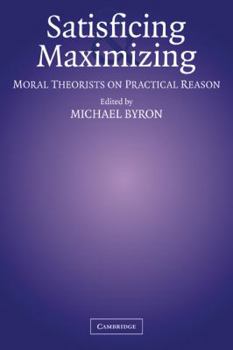
Satisficing and Maximizing: Moral Theorists on Practical Reason


Select Format
Select Condition 
Book Overview
This collection of essays explores two competing views of practical rationality. How do we think about what we plan to do? One dominant answer is that we select the best possible option available. However, a growing number of philosophers would offer a different reply. Since we are not equipped to maximize, we must often choose the next best alternative--one that is no more than satisfactory. This strategy choice is called satisficing (a term coined by the economist Herb Simon).
Format:Paperback
Language:English
ISBN:0521010055
ISBN13:9780521010054
Release Date:July 2004
Publisher:Cambridge University Press
Length:256 Pages
Weight:0.05 lbs.
Dimensions:0.7" x 5.9" x 9.0"
Customer Reviews
1 rating
Virture is not Absolute
Published by Thriftbooks.com User , 16 years ago
I first became interested in the notion of satisficing in my university days when I read Herbert Simon's "Sciences of the Artificial" and the idea stuck with me. He applied to the notion of an explanation. While the search for absolute truth was admirable we often stop at an explanation that is "good enough". There are excellent reasons for this such as lack of time, knowledge or an assessment that the current level of explanation is sufficient for practical utilitarian needs. The lesson I learned from this is OK to be a bit lazy and be satisfied with what you have because of diminishing returns for the effort of coming up with something better. This is contrasted with a strategy of maximizing. Think "Type A" personality - maximizing vs "Type B" satisficing. "Satisficing and Maximizing" looks at applying this principle to morality. There are 12 essays including an introduction by editor Michael Byron. David Schmidtz introduces John Pollock's delightful dilemma of the immortal who has the only bottle of EverBetter Wine that gets tastier by the day - when should she drink it. A maximizer would say never, a satisficer would find a reasonable moment and share it with some friends. Michael Weber's "A New Defense of Satisficing". was a thoughtful excursion in the role of narrative in determining a valuation of a good life or good decision. James Dreier's look at the "Prisoner's Dilemna" and Tyler Cowen's take on economic satisficing use satisficing to explain the choices made in game theory. Michael Byron's "Could Aristotle Satisifice" which casts satisficing as an old idea, but differs from Aristotle's idea of moderation in that it is in and of itself not intrinsically virtuous. These were the most interesting excursions to me generally all of the writing is strong and worth following. Is this the best possible treatment? No, but then, given the subject, it is good enough. ;-) It piques one's interests and I found it inspired thinking about how to apply the principles to other scenarios. Its written at a 3rd year University level or higher so I don't recommend it to everyone. Like many philosophy books there are multiple references to previous works, terms coined by other authors for a specific purpose and at times its a bit pendantic. Recommended for philosphy students or those interested in practical application of ethical principles such as social activists, business managers, and practicing ethicists such as clergy or decision makers in business, medicine or politics.
Copyright © 2025 Thriftbooks.com
Terms of Use | Privacy Policy | Do Not Sell/Share My Personal Information | Cookie Policy | Cookie Preferences | Accessibility Statement
ThriftBooks ® and the ThriftBooks ® logo are registered trademarks of Thrift Books Global, LLC
ThriftBooks ® and the ThriftBooks ® logo are registered trademarks of Thrift Books Global, LLC
