


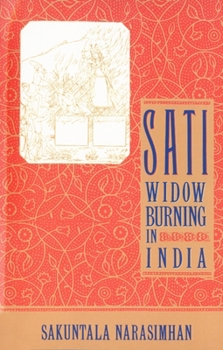
Sati - Widow Burning in India


Select Format
Select Condition 
Book Overview
Bombay journalist Narasimhan here offers an unnerving, carefully documented study of the Indian ritual whereby widows bring glory on themselves and their families by self-immolation on the pyres of their dead husbands. According to the author, the Hindi scriptures, which evolved from the second millennium B.C. to the second millennium A.D., sometimes suggest or sanction sati but this endorsement is equivocal. She further illustrates how, throughout Indian history, sati rituals must be seen as part of a wider canvas of social attitudes that denigrate women; a widow's life is particularly wretched and even today widows are routinely excluded from various religious functions and festivities. Although sati was officially outlawed in 1829, the rite persists: the book points to the 1987 self-immolation of 18-year-old Roop Kanwar in the presence of a crowd of 4,000, an act that incited nationwide pro- and anti-sati sentiment. Narasimhan demonstrates how the combination of a number of factors; lack of education, religious and economic compulsions and male chauvinism; help to explain how a culture rooted in the tenets of compassion and nonviolence can encourage the burning of its widows.
Format:Paperback
Language:English
ISBN:0385423179
ISBN13:9780385423175
Release Date:July 1992
Publisher:Anchor Books
Length:216 Pages
Weight:0.52 lbs.
Dimensions:0.6" x 5.2" x 8.0"
Customer Reviews
2 ratings
Pativrata
Published by Thriftbooks.com User , 20 years ago
A well-researched book, Sati explores the historical background of the practice of sati; a widow's self-immolation on the funeral pyre of her husband. The author traces back the first incidents of sati in Hinduism, and then examines the position of the sacred textual traditions in relation to the practice. While she's done a fantastic job in researching her topic, the relentlessness of her sarcasm disqualifies her work from being a scholarly source of information. The title is also misleading. It implies that widows are burned in India, but sati is clearly defined as a widow's self-immolation and self-sacrifice. The author adopts a secular, feminist position in discussing her topic. This is a good book if you're looking for arguments against sati, but if you're seeking to understand sati in its religious and cultural context, this may not be the right place to start. Although I do not condone the practice, as a social scientist, and in an effort to remain objective, I think it is best to look at the practice in its historical context.
Powerful study on widow burning in India
Published by Thriftbooks.com User , 20 years ago
Sakuntala Narasimhan's study on widow burning in India is a powerful one. Carefully and extensively researched, it provides a solid history and contemporary analysis of the practice. Narasimhan takes a firmly anti-sati stance, at times providing biting commentary on pro-sati activists, and it's clear that she is writing from a feminist/womanist point of view. This is a must-read for those studying women's issues in India and Hindu culture, and would be a good read for those interested in women's issues in the world in general. The book is nearly 15 years old now, and thus a bit dated in some ways, but is still relevant in terms of its unflinching historical and cultural analysis, and in that way should be regarded as a classic work on the subject. The edition I read was an Indian edition, and I am not sure if this edition has been edited for an American audience - there are small vocabulary issues that may confuse a reader (for instance, the word "lakh" is an Indian unit of measurement equal to 100,000, and there are a few passages of untranslated and improperly transliterated Sanskrit, though they are explained in the text), but overall it is an extremely well-written, very readable and I would dare say nearly indispensable study on the practice of sati.
Copyright © 2026 Thriftbooks.com
Terms of Use | Privacy Policy | Do Not Sell/Share My Personal Information | Cookie Notice | Cookie Preferences | Accessibility Statement
ThriftBooks ® and the ThriftBooks ® logo are registered trademarks of Thrift Books Global, LLC
ThriftBooks ® and the ThriftBooks ® logo are registered trademarks of Thrift Books Global, LLC
