


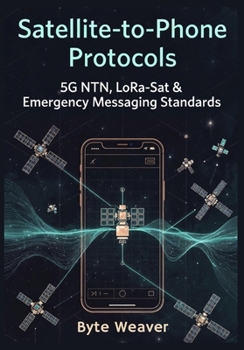
Satellite-to-Phone Protocols 5G NTN, LoRa-Sat & Emergency Messaging Standards

What if "no signal" was no longer an acceptable outcome-anywhere on Earth?
For decades, mobile connectivity quietly depended on a fragile assumption: if you leave the reach of a cell tower, communication becomes optional. Mountains, oceans, disaster zones, airspace, and remote regions were treated as statistical noise rather than design requirements. Satellite phones existed, but they remained isolated-separate devices, separate economics, separate standards.
That separation is ending.
Satellite-to-Phone Protocols explains the structural shift underway as satellites become native participants in the mobile ecosystem. Through the lens of 5G Non-Terrestrial Networks (NTN), LoRa-Satellite messaging, and emergency communication standards, this book examines how modern smartphones are beginning to exchange signals directly with space-based infrastructure-without external hardware or specialized terminals.
Rather than promising universal broadband, these systems prioritize something more fundamental: reachability under constraint.
Inside, you'll explore:
Why "global coverage" was always an economic claim, not a technical reality
How 5G NTN integrates satellites into standard cellular architectures
What low-power, store-and-forward satellite messaging actually enables-and what it does not
Why emergency connectivity is now a first-class network requirement
The trade-offs between latency, power, reliability, openness, and regulation
Where satellite-to-phone systems fit within real products, policies, and deployments
Written for engineers, architects, regulators, researchers, and technology leaders, this book emphasizes systems thinking over marketing narratives. It avoids speculative futurism and focuses on standards, constraints, and operational consequences.
Satellite connectivity is often called revolutionary. The real change is quieter: integration. When space-based networks become ordinary infrastructure, failure modes-and responsibilities-change.
This book provides the clarity needed to understand that shift before it fades into the background.
Customer Reviews
ThriftBooks® and the ThriftBooks® logo are registered trademarks of Thrift Books Global, LLC
