


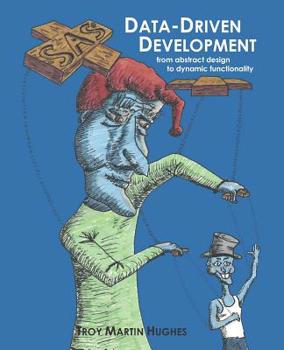
SAS Data-Driven Development: From Abstract Design to Dynamic Functionality

This text introduces high-level design concepts, patterns, and principles, after which real-world scenarios demonstrate SAS development best practices: Part I. Data-Driven Design: Learn how to harness procedural abstraction, data abstraction, iteration abstraction, software modularity, and data independence, with concepts drawn from object-oriented programming (OOP), master data management (MDM), table-driven design, and business rules engines.Part II. Control Data: Understand the limitless data structures that can drive SAS software, including parameters, configuration files, control tables, decision tables, SAS data sets, SAS arrays, and CSV, Excel, XML, and CSS files. Interoperability is modeled through control data that can be accessed by SAS and other applications.
Throughout the text, requirements-based examples demonstrate data analysis, data modeling, data mapping, data governance, dynamic "traffic light" reporting, and other use cases. Examples contrast concrete, code-driven design with abstract, data-driven design to illustrate the clear advantages of the latter.
Application of the SAS Macro Language often signifies the first milestone in a SAS practitioner's career — because macros facilitate flexible, reusable software. Data-driven design represents the next milestone and this text provides the guidebook for that incredible journey. Start your journey today
Customer Reviews
ThriftBooks® and the ThriftBooks® logo are registered trademarks of Thrift Books Global, LLC
