


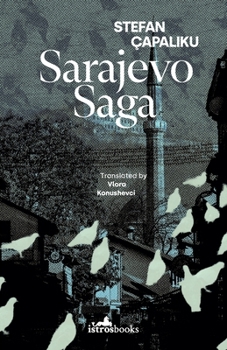
Sarajevo Saga

April 2024. A well-known Albanian writer arrives in Sarajevo for a one-month literary residency. By the next day, he realizes he has no real idea what to write about.
At the same time, a photograph weighs heavily in his pocket, a portrait of four children, cousins, who had left Albania for Sarajevo during the aftermath of the First World War. Their names, and the shared surname Cukali, are handwritten on the back.Should he write about a writer's creative paralysis, or should he trace the footsteps of a forgotten family history that began over a century ago in this very city, transforming his residency into a journey of excavation, longing, and ancestral memory?
At this point, the novel splits into two narrative strands that twist and braid like a double helix: the story of a poor family leaving Shkod r with the retreating Austro-Hungarian army in 1918, and the writer's contemporary search for their descendants in today's Sarajevo. The movement in time spans over a century. The movement in space crosses more than 500 miles. Meanwhile, the writer's investigation leads him back through time, growing darker, more fragmented-and more dangerous.
Customer Reviews
ThriftBooks ® and the ThriftBooks ® logo are registered trademarks of Thrift Books Global, LLC
