


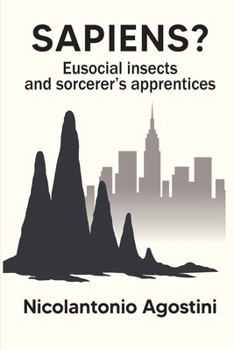
Sapiens?: Eusocial insects and sorcerer's apprentices
No Customer Reviews

Complex societies represent one of evolution's greatest enigmas. How and why have some species developed advanced social structures based on cooperation and division of labor, even at the expense of individual reproductive success? And above all, what has made humans the only ultrasocial animals? Starting from the study of eusocial insects (ants, bees, termites) and their organizational model, the author draws a connecting thread that leads to humans, exploring the biological and cultural roots of our cooperation. Through an analysis ranging from kin selection to multilevel selection, from patriarchy to the neurobiology of political ideology, this book investigates the mechanisms that allowed Homo sapiens to build large-scale societies based on cooperation among non-kin individuals, along with the challenges and paradoxes that arise. The Agricultural Revolution marked a crucial turning point toward ultrasociality, transforming our cooperative nature and redefining the relationship between individual and community. But was this evolution truly a success? Ultrasociality made us more powerful, but also more fragile: inequality, conflict, the cognitive limits of our social brain, and globalization confront humanity with an unprecedented crisis. Will we be able to manage the social model we have created, or are we doomed to fall victim to our own evolutionary dynamics? With a multidisciplinary approach intertwining biology, anthropology, neuroscience, economics, and politics, Sapiens? Eusocial Insects and Sorcerer's Apprentices offers a profound reflection on the future of humanity and the urgent need for radical change to avoid the collapse of our civilization.
Format:Paperback
Language:English
ISBN:B0FL75CKX2
ISBN13:9798294247362
Release Date:July 2025
Publisher:Independently Published
Length:188 Pages
Weight:0.57 lbs.
Dimensions:0.4" x 6.0" x 9.0"
Customer Reviews
0 rating
Copyright © 2026 Thriftbooks.com
Terms of Use | Privacy Policy | Do Not Sell/Share My Personal Information | Cookie Notice | Cookie Preferences | Accessibility Statement
ThriftBooks ® and the ThriftBooks ® logo are registered trademarks of Thrift Books Global, LLC
ThriftBooks ® and the ThriftBooks ® logo are registered trademarks of Thrift Books Global, LLC
