


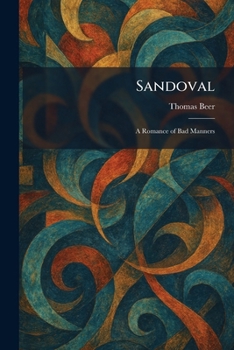
Sandoval: A Romance of Bad Manners

Set against the vibrant backdrop of 1870s New York, "Sandoval: A Romance of Bad Manners" is a sophisticated exploration of the social intricacies and hidden scandals of the Gilded Age. This masterful novel by Thomas Beer follows young Christian Gaar as his comfortable life is disrupted by the sudden arrival of a mysterious stranger named Sandoval. Sandoval, a man of enigmatic origins and blunt manners, claims that Christian's father owes a significant debt-a claim that threatens to unearth buried secrets and challenge the family's high-standing reputation.
As the narrative unfolds, Beer provides a sharp-witted critique of the post-Civil War American elite, contrasting the polished veneer of high society with the raw, often "bad" manners that lie beneath the surface. Through its atmospheric prose and sharp characterizations, the book captures the restless spirit of a transforming city caught between tradition and modern ambition. "Sandoval: A Romance of Bad Manners" stands as a significant work of early 20th-century historical fiction, offering a vivid portrait of a bygone era and a timeless study of inheritance, honor, and the complexities of social status.
This work has been selected by scholars as being culturally important, and is part of the knowledge base of civilization as we know it. This work was reproduced from the original artifact, and remains as true to the original work as possible. Therefore, you may see the original copyright references, library stamps (as most of these works have been housed in our most important libraries around the world), and other notations in the work.
This work is in the public domain in the United States of America, and possibly other nations. Within the United States, you may freely copy and distribute this work, as no entity (individual or corporate) has a copyright on the body of the work.
As a reproduction of a historical artifact, this work may contain missing or blurred pages, poor pictures, errant marks, etc. Scholars believe, and we concur, that this work is important enough to be preserved, reproduced, and made generally available to the public. We appreciate your support of the preservation process, and thank you for being an important part of keeping this knowledge alive and relevant.
Customer Reviews
ThriftBooks ® and the ThriftBooks ® logo are registered trademarks of Thrift Books Global, LLC
