
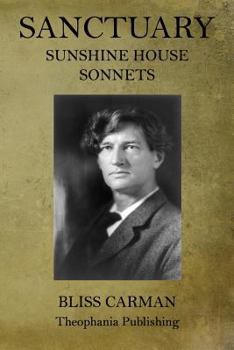
"Sanctuary: Sunshine House Sonnets" is a poignant and evocative collection of lyric poetry by the acclaimed Canadian poet Bliss Carman. Published in the final year of his life, this work reflects a profound sense of peace and spiritual repose, showcasing Carman's signature mastery of rhythm and his deep, enduring connection to the natural world.
Through the disciplined structure of the sonnet, Carman explores themes of inner sanctuary, the healing power of nature, and the quiet beauty found in everyday moments. The "Sunshine House" of the title serves as a metaphor for a place of light and refuge, where the soul finds harmony amidst the changing seasons and the passage of time. These poems represent a transition from the exuberant romanticism of his earlier "vagabond" verse toward a more contemplative and serene maturity.
As a significant contribution to early 20th-century Canadian literature, "Sanctuary: Sunshine House Sonnets" offers readers a timeless exploration of grace and tranquility. It remains a testament to Carman's legacy as one of Canada's most celebrated poets and his ability to capture the subtle nuances of the human spirit in relation to its environment.
This work has been selected by scholars as being culturally important, and is part of the knowledge base of civilization as we know it. This work was reproduced from the original artifact, and remains as true to the original work as possible. Therefore, you may see the original copyright references, library stamps (as most of these works have been housed in our most important libraries around the world), and other notations in the work.
This work is in the public domain in the United States of America, and possibly other nations. Within the United States, you may freely copy and distribute this work, as no entity (individual or corporate) has a copyright on the body of the work.
As a reproduction of a historical artifact, this work may contain missing or blurred pages, poor pictures, errant marks, etc. Scholars believe, and we concur, that this work is important enough to be preserved, reproduced, and made generally available to the public. We appreciate your support of the preservation process, and thank you for being an important part of keeping this knowledge alive and relevant.
