


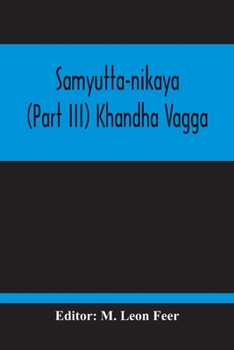
Samyutta-Nikaya (Part III) Khandha Vagga
No Customer Reviews

A brisk, uncompromising window into the mechanics of experience. Samyutta-Nikaya (Part III) Khandha Vagga presents a compact buddhist scripture anthology drawn from the Pali Canon, laying out the Buddha's analysis of what makes a person - without flourish, without obscurity. Essential for students of Buddhism. These early buddhist texts, gathered from the Sutta Pitaka, centre on the five aggregates doctrine: a sustained enquiry into body, feeling, perception, formations and consciousness that underpins much of the teachings of the Buddha. Read as part of a pali canon collection, the material functions as spiritual literature and philosophical argument; it is at once devotional, diagnostic and sharply practical. Casual readers interested in buddhist philosophy study will find clear entry points; meditation teachers and practitioners will recognise the doctrinal scaffolding; scholars and religious studies reference users will value the canonical fidelity and concise presentation. For those reading the Dhammapada or other suttas, this volume offers a direct companion to deepen understanding. Republished by Alpha Editions in a careful modern edition, this volume preserves the spirit of the original while making it effortless to enjoy today - a heritage title prepared for readers and collectors alike. Literarily and historically, the Samyutta-Nikaya is a cornerstone of theravada buddhist literature and a principal element of ancient India Buddhism's preserved discourse; Part III's Khandha Vagga is particularly significant for scholars tracing the doctrine of non-self and the practical methods of insight. The edition here balances fidelity to the source with editorial clarity, making it equally fit for casual reading and for classic literature collectors assembling a pali canon collection. Compact, authoritative and thoughtfully presented, it serves as both an introductory pathway for students of buddhism and a concise religious studies reference for libraries. It also functions as a compact sutta pitaka guide for comparative study and course use. Each passage's economy rewards repeated study; short discourses are well suited to classroom discussion, to personal reflection, and to comparative reading alongside the Dhammapada.
Format:Paperback
Language:English
ISBN:9354213936
ISBN13:9789354213939
Release Date:November 2020
Publisher:Alpha Edition
Length:306 Pages
Weight:0.99 lbs.
Dimensions:0.7" x 6.0" x 9.0"
Customer Reviews
0 rating
Copyright © 2026 Thriftbooks.com Terms of Use
| Privacy Policy | Do Not
Sell/Share My Personal Information | Cookie Policy | Cookie Preferences | Accessibility Statement
ThriftBooks® and the ThriftBooks® logo are registered trademarks of Thrift Books Global, LLC
ThriftBooks® and the ThriftBooks® logo are registered trademarks of Thrift Books Global, LLC
