


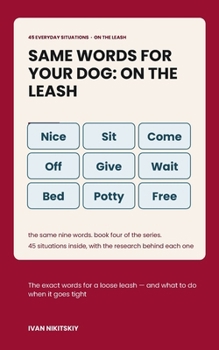
Same Words for Your Dog: On the Leash: Reward-Based Training for Walking Without Pulling

He hits the end of the leash and the walk turns into a negotiation you lose twice a day. In one survey of owners, more than four in five said their dog pulls. The usual answer arrives in the shape of harder hardware. This book tells you what to say instead, what to change, and what you should be seeing a week later.
Forty-five situations from the first walk to the last block, each on one spread: what a leash can and cannot do, collar against harness against head halter, fitting gear that does not rub, tags and the number that brings him back, what your hand does with the line, wearing the gear indoors first, the door, hallways and the elevator, standing on a sidewalk while nothing happens, where a first walk ends, telling him the sniffing can start, what slack actually looks like, marking the moment it goes soft, the side you pick and how you pay for it, turning before he gets ahead, his pace and yours, standing still when the line goes tight, why pulling works for him, pulling as no claim on the household, what a harness does not fix, practicing on a route he knows, squirrels and cats, everybody who holds the leash, picking things up off the ground, trading for what is in his mouth, potty on the walk, puddles and treated lawns, how much of the walk belongs to his nose, passing another dog on a narrow sidewalk, saying no to a greeting, sitting while somebody says hello, jumping on people, children and strollers, dogs behind fences, traffic and curbs, heat and hot asphalt, rain and salted feet, walking after dark, coming out of the collar, planting his feet, fear outside, barking and lunging, pain you cannot see, aversive collars, and who to call.
Nine words, and everyone in the house uses the same nine. One word means one thing and never two. The list is printed at the front, and every spread says which of the nine it uses. The same nine run through every book in the series.
The research behind every page is named. The American Veterinary Society of Animal Behavior on humane training. The American Animal Hospital Association on management and referral. Around them: Shih and colleagues, who put a tension meter on the leash of fifty-two dogs; Carter and colleagues on the pressure a collar puts on a neck model under a sharp pull; Pauli and colleagues on what a collar does to pressure inside the eye; Townsend and colleagues on pulling as a welfare problem; Casey and colleagues on how little one context predicts another; Meints and colleagues, who found most four-year-olds read a threatening dog face as a smile.
It also says where the evidence is thin. A harness protects his neck and does not stop the pulling, and the study that shows it tested only one kind. Prong collars and choke chains have not been tested the way electronic collars have, and the book says which of its objections rest on evidence and which on a professional position. Where a source was funded by a company with something to sell, that is disclosed at the back with the company named.
No brand of leash, harness, collar or food is named anywhere in it.
Barking and lunging at other dogs is a fear problem before it is a manners problem, and the pages that touch it send you to a veterinarian rather than to another week of trying.
Book four of Same Words for Dogs, and it stands alone.
Educational material. Not veterinary advice.Customer Reviews
ThriftBooks ® and the ThriftBooks ® logo are registered trademarks of Thrift Books Global, LLC
