


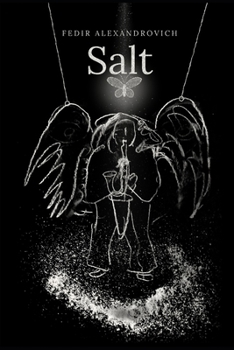
Salt: Selected Works

Salt is scattered on the threshold to ward off evil. It is offered with bread to welcome a guest. It is pressed into a wound so the wound remembers. And salt is what remains on the cheeks after the tears have dried.
This book begins where the familiar world ended: in Chornobyl. One day in the Zone, where time stopped but memory still glows through the concrete, becomes the entrance to a labyrinth from which no one returns unchanged.
Salt is more than a collection. It is a ritual in six acts. Poetry, drama and prose weave together into a single incantation: against forgetting, against silence, against the death that comes too early for the best of us.
The poems Red Snow and Paradise Field are a bridge between the world of the living and the world of those who have gone. The monodrama The Shovel is a conversation between a man and the earth, which can both feed and bury. The play Deafness is about a world that has stopped listening. The tragedy Muteness, written by the laws of ancient theatre, with a chorus and a coryphaeus, speaks aloud the names of those who can no longer speak for themselves. And the memoir-novel ORPHEUS-27 follows Orpheus down into the underworld and back again, to the place where victory and death walk side by side.
The author, Fedir Alexandrovich, is a Ukrainian artist, stage designer and writer, and the protagonist of the documentary The Russian Woodpecker, winner of the Sundance Grand Jury Prize. More than forty productions he designed for theatres in Ukraine and Germany taught him the essential truth: the stage is where the dead return to be heard.
The book is dedicated to the memory of Yaroslav Kmytko (1997-2025).
Open it the way you open a door on the night before the day of the dead. Place a pinch of salt on the threshold. And listen.
Customer Reviews
ThriftBooks ® and the ThriftBooks ® logo are registered trademarks of Thrift Books Global, LLC
