


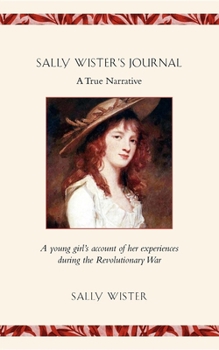
Sally Wister's Journal

Select Format
Select Condition 
Book Overview
The diary of a young girl during the Revolutionary War. In 1775 Sally Wister was sent to the countryside to avoid harm. This is a delightful historical record of a young girl's life during a perilous and all-important time in American history.
Format:Paperback
Language:English
ISBN:1557091145
ISBN13:9781557091147
Release Date:April 1995
Publisher:Applewood Books
Length:64 Pages
Weight:0.31 lbs.
Dimensions:0.2" x 5.0" x 7.3"
Age Range:3 years and up
Grade Range:Preschool and higher
Customer Reviews
4 ratings
Real Diary of a Real Girl...
Published by Thriftbooks.com User , 18 years ago
In 1775 the British invaded Philadelphia and Sally Wister, a young Quaker, was sent into the countryside to protect her from harm. While most of it deals with her stay in the country and her interaction with officers of the American Army, it is also shows the fears, dreams and hopes of a girl during the time of the Revolutionary War. True, being a Quaker she is against war and this makes for a interesting first person point of view. A must for any library on early American history, women's history and the American Revolution.
American Revolutionary War Journal, from a Quaker Teenager
Published by Thriftbooks.com User , 25 years ago
><p>Sally Wister was a 16-year-old Quaker maiden when the British, who had already overtaken New York, threatened Philadelphia. Her family left the city for the safety of the farm of William & Hannah Foulke ("Aunt" Foulke), some 15 miles from the city, in the countryside of Gwynedd, Pennsylvania.<p>From September 1777 to July 1778, she kept a journal to tell her friend Debby everything that happened, as the American Army marched by and the British invaded their encampment 6 miles away, and she offered descriptions from headquarters, to camps, to social occasions.<p>During those months, the British captured Philadelphia, battles and skirmishes were held, Burgoyne surrendered, General Washington entrenched at Whitemarsh, and then encamped for the winter at Valley Forge, a cabal rose against Washington, France acknowledged American independence, and, finally, the British withdrew.<p>This girl, at once a proper Quaker maiden and an enthralled teenager, met with (and fancied) Continental officers, hosted General Smallwood, visited the Americans' camps, and showed us real examples of the fears of war, when brought to your door. (The Quakers were sympathetic to the cause of the revolution, but religiously anti-war.)<p>This is a terrific resource -- reading like a novel, yet a real, historical autobiography, a primary source, showing the human side of the American Revolution, as the war swirled around her. Written in the language and spelling of the day, it offers a fresh and vital look<p>The republication of the 1902 edition of the book offers an excellent Introduction by Albert Cook Meyers, placing all the events in context and giving the Wister and Foulke family backgrounds.
American Revolutionary War Journal, from a Quaker Teenager
Published by Thriftbooks.com User , 25 years ago
Sally Wister was a 16-year-old Quaker maiden when the British, who had already overtaken New York, threatened Philadelphia. Her family left the city for the safety of the farm of William & Hannah Foulke ("Aunt" Foulke), some 15 miles from the city, in the countryside of Gwynedd, Pennsylvania.From September 1777 to July 1778, she kept a journal to tell her friend Debby everything that happened, as the American Army marched by and the British invaded their encampment 6 miles away, and she offered descriptions from headquarters, to camps, to social occasions.During those months, the British captured Philadelphia, battles and skirmishes were held, Burgoyne surrendered, General Washington entrenched at Whitemarsh, and then encamped for the winter at Valley Forge, a cabal rose against Washington, France acknowledged American independence, and, finally, the British withdrew.This girl, at once a proper Quaker maiden and an enthralled teenager, met with (and fancied) Continental officers, hosted General Smallwood, visited the Americans' camps, and showed us real examples of the fears of war, when brought to your door. (The Quakers were sympathetic to the cause of the revolution, but religiously anti-war.)This is a terrific resource -- reading like a novel, yet a real, historical autobiography, a primary source, showing the human side of the American Revolution, as the war swirled around her. Written in the language and spelling of the day, it offers a fresh and vital lookThe republication of the 1902 edition of the book offers an excellent Introduction by Albert Cook Meyers, placing all the events in context and giving the Wister and Foulke family backgrounds.
American Revolutionary War Journal, from a Quaker Teenager
Published by Thriftbooks.com User , 25 years ago
... Sally Wister was a 16-year-old Quaker maiden when the British, who had already overtaken New York, threatened Philadelphia. Her family left the city for the safety of the farm of William & Hannah Foulke ("Aunt" Foulke), some 15 miles from the city, in the countryside of Gwynedd, Pennsylvania.From September 1777 to July 1778, she kept a journal to tell her friend Debby everything that happened, as the American Army marched by and the British invaded their encampment 6 miles away, and she offered descriptions from headquarters, to camps, to social occasions.During those months, the British captured Philadelphia, battles and skirmishes were held, Burgoyne surrendered, General Washington entrenched at Whitemarsh, and then encamped for the winter at Valley Forge, a cabal rose against Washington, France acknowledged American independence, and, finally, the British withdrew.This girl, at once a proper Quaker maiden and an enthralled teenager, met with (and fancied) Continental officers, hosted General Smallwood, visited the Americans' camps, and showed us real examples of the fears of war, when brought to your door. (The Quakers were sympathetic to the cause of the revolution, but religiously anti-war.)This is a terrific resource -- reading like a novel, yet a real, historical autobiography, a primary source, showing the human side of the American Revolution, as the war swirled around her. Written in the language and spelling of the day, it offers a fresh and vital look at the War.Another edition, the Library-Binding republication of the 1902 edition, offers an excellent Introduction by Albert Cook Meyers, placing all the events in context and giving the Wister and Foulke family backgrounds.
Copyright © 2026 Thriftbooks.com
Terms of Use | Privacy Policy | Do Not Sell/Share My Personal Information | Cookie Policy | Cookie Preferences | Accessibility Statement
ThriftBooks ® and the ThriftBooks ® logo are registered trademarks of Thrift Books Global, LLC
ThriftBooks ® and the ThriftBooks ® logo are registered trademarks of Thrift Books Global, LLC
