


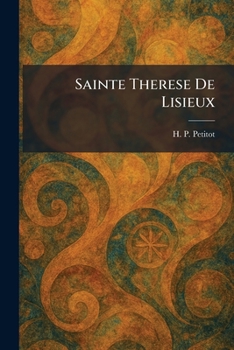
Sainte Therese De Lisieux

"Sainte Therese De Lisieux" by R.P.H. Petitot, O.P., offers a profound and insightful exploration of the life and spiritual doctrine of Saint Th r se of the Child Jesus and the Holy Face. Written by a distinguished Dominican theologian, this work delves into the "Little Way" of spiritual childhood that transformed the landscape of modern Catholic devotion. Petitot examines the psychological and spiritual depth of the Carmelite nun, tracing her journey from her early years in Alen on to her hidden life within the monastery at Lisieux.
The book provides a rigorous yet accessible analysis of Th r se's unique path to holiness, emphasizing her commitment to simplicity, humility, and absolute trust in God's mercy. By situating her experiences within the broader context of Christian mysticism, Petitot illustrates why this young nun became one of the most beloved and influential saints of the twentieth century. Readers will find a detailed portrait of a soul who sought to do small things with great love, making this an essential volume for those interested in hagiography, Catholic spirituality, and the enduring legacy of the Little Flower.
This work has been selected by scholars as being culturally important, and is part of the knowledge base of civilization as we know it. This work was reproduced from the original artifact, and remains as true to the original work as possible. Therefore, you may see the original copyright references, library stamps (as most of these works have been housed in our most important libraries around the world), and other notations in the work.
This work is in the public domain in the United States of America, and possibly other nations. Within the United States, you may freely copy and distribute this work, as no entity (individual or corporate) has a copyright on the body of the work.
As a reproduction of a historical artifact, this work may contain missing or blurred pages, poor pictures, errant marks, etc. Scholars believe, and we concur, that this work is important enough to be preserved, reproduced, and made generally available to the public. We appreciate your support of the preservation process, and thank you for being an important part of keeping this knowledge alive and relevant.
Customer Reviews
ThriftBooks ® and the ThriftBooks ® logo are registered trademarks of Thrift Books Global, LLC
