


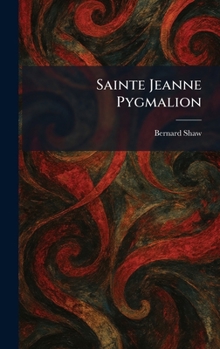
Sainte Jeanne Pygmalion

"Sainte Jeanne Pygmalion" presents two of George Bernard Shaw's most influential and enduring theatrical masterpieces. In "Saint Joan", Shaw dramatizes the life and trial of Joan of Arc, depicting her as a tragic heroine whose unwavering faith and practical intelligence challenged the political and religious hierarchies of the Middle Ages. This chronicle play delves into themes of nationalism, individual conscience, and the struggle between institutional power and personal revelation, solidifying its place as a cornerstone of historical drama.
Alongside this profound tragedy is "Pygmalion", a sharp-witted social satire that remains one of Shaw's most popular works. The play follows Professor Henry Higgins as he attempts to transform Eliza Doolittle, a working-class flower girl, into a refined lady of society through the teaching of phonetics. Shaw uses this premise to deliver a biting critique of the British class system and the rigid social structures of his time. This collection highlights Shaw's exceptional ability to combine intellectual depth with engaging storytelling, offering readers a comprehensive look at his contributions to 20th-century literature and theater.
This work has been selected by scholars as being culturally important, and is part of the knowledge base of civilization as we know it. This work was reproduced from the original artifact, and remains as true to the original work as possible. Therefore, you may see the original copyright references, library stamps (as most of these works have been housed in our most important libraries around the world), and other notations in the work.
This work is in the public domain in the United States of America, and possibly other nations. Within the United States, you may freely copy and distribute this work, as no entity (individual or corporate) has a copyright on the body of the work.
As a reproduction of a historical artifact, this work may contain missing or blurred pages, poor pictures, errant marks, etc. Scholars believe, and we concur, that this work is important enough to be preserved, reproduced, and made generally available to the public. We appreciate your support of the preservation process, and thank you for being an important part of keeping this knowledge alive and relevant.
Related Subjects
DramaCustomer Reviews
ThriftBooks ® and the ThriftBooks ® logo are registered trademarks of Thrift Books Global, LLC
