


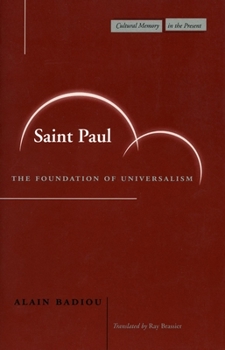
Saint Paul: The Foundation of Universalism

Select Format
Select Condition 
Book Overview
This book revisits and revises some of the most basic concepts of time in the Judeo-Christian tradition, drawing on St. Paul's writings to rethink a new kind of radical faith in truth as an event, as the advent of the incalculable, a modality that remakes the pairing religious/secular.
Format:Paperback
Language:English
ISBN:0804744718
ISBN13:9780804744713
Release Date:May 2003
Publisher:Stanford University Press
Length:128 Pages
Weight:0.55 lbs.
Dimensions:0.5" x 6.3" x 8.5"
Customer Reviews
2 ratings
Enter Badiou
Published by Thriftbooks.com User , 21 years ago
This fantastic little book is one of Badiou's best. The US was first introduced to Badiou with his book "Ethics"--and I believe it would benefit any reader to go to that book first before reading "Saint Paul." But for those who are aware of Badiou's overall project, this book will provide fascinating reading. Here, Badiou goes into why he thinks Universality is an important and indispencible concept for politics. He goes into how Global Capitalism has thrived off fractures and splinters in identity, and how constructing a universal community is necessary for any struggle against capitalism. He also goes into a detailed analysis of the subject through the figure of Saint Paul. If you are looking for an actual commentary on Saint Paul, then, this is not the book for you. If you already dislike, or do not understand what Badiou's is trying to accomplish, then, this book will do little for you. But, if you are truly intrigued by this philosopher, and if you are quite aware of his prose and dependence upon set theory and mathematical concepts, then, Saint Paul will be of great interest to you.
Truth and Testimony
Published by Thriftbooks.com User , 21 years ago
This book provides a very novel insight not only on Paul but on Christian theology as well. One of the most interesting reflections is the differentiation between the philosophical discourse of wisdom (Greece), the prophetic discourse of signs (Israel) and the testimony of the event (Christianity). There is no pagan conformism to the laws of the universe nor a cryptic awaiting for a promise, but an event that concerns us all in terms of placing ourselves in a place beyond the automatism of the Law, in a world of Life. The main figure is not of the prophet or the philosopher but of the apostol, the one who testifies of a universal truth where there is no difference between I and the Other. Badiou's interpretation of Saint Paul does not compromise itself with received scholastic theology where there is a continuity of God with Being (analogia entis) nor with a postmodern theology where the promise is something to be kept differing forever in order to "do justice" to the Other. Badiou provides a universalist theory that includes the difference but where there is no difference and boundaries for the sake of the ethical. No Jew nor Greek, no men nor women, to be all to all men.
Copyright © 2026 Thriftbooks.com Terms of Use
| Privacy Policy | Do Not
Sell/Share My Personal Information | Cookie Policy | Cookie Preferences | Accessibility Statement
ThriftBooks® and the ThriftBooks® logo are registered trademarks of Thrift Books Global, LLC
ThriftBooks® and the ThriftBooks® logo are registered trademarks of Thrift Books Global, LLC
