


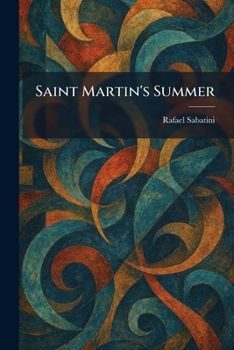
Saint Martin's Summer

Select Format
Select Condition 
Book Overview
"Saint Martin's Summer" is a captivating work of historical fiction set against the vibrant and perilous backdrop of seventeenth-century France. Penned by the master of the swashbuckling genre, Rafael Sabatini, the narrative follows the adventures of Martin de Bartolom , a soldier of fortune whose life takes a dramatic turn when he is tasked with a mission of chivalry and danger.
Sent to the Ch teau de Lavedan, Martin must navigate a web of political intrigue and familial conflict to save a young noblewoman from an unwanted marriage and the machinations of those who seek to exploit her. Blending romance with high-stakes action, the story captures the essence of the era's courtly manners and volatile power struggles. Sabatini's signature style shines through in the sharp dialogue, intricate plotting, and vivid atmosphere that brings the French countryside and its aristocratic tensions to life.
"Saint Martin's Summer" is a classic example of the adventure novel, exploring themes of honor, loyalty, and the unexpected arrival of love-the "Indian summer" of the heart-amidst the chaos of a kingdom in transition. Readers will find themselves swept away by this tale of a hero who faces overwhelming odds with courage and wit.
This work has been selected by scholars as being culturally important, and is part of the knowledge base of civilization as we know it. This work was reproduced from the original artifact, and remains as true to the original work as possible. Therefore, you may see the original copyright references, library stamps (as most of these works have been housed in our most important libraries around the world), and other notations in the work.
This work is in the public domain in the United States of America, and possibly other nations. Within the United States, you may freely copy and distribute this work, as no entity (individual or corporate) has a copyright on the body of the work.
As a reproduction of a historical artifact, this work may contain missing or blurred pages, poor pictures, errant marks, etc. Scholars believe, and we concur, that this work is important enough to be preserved, reproduced, and made generally available to the public. We appreciate your support of the preservation process, and thank you for being an important part of keeping this knowledge alive and relevant.
Customer Reviews
ThriftBooks ® and the ThriftBooks ® logo are registered trademarks of Thrift Books Global, LLC
