


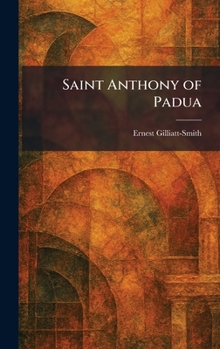
Saint Anthony of Padua

"Saint Anthony of Padua" is a comprehensive and reverent exploration of the life, ministry, and enduring legacy of one of the Catholic Church's most popular and influential figures. Written by Ernest Gilliat-Smith, this work meticulously charts the journey of the Portuguese friar who became a cornerstone of the Franciscan Order. From his early years as an Augustinian monk to his transformative encounter with the mission of Saint Francis of Assisi, the narrative captures Anthony's transition into a world-renowned preacher and theologian.
The book highlights Saint Anthony's legendary oratorical skills and his profound knowledge of the Scriptures, which earned him the title "Ark of the Testament." Beyond his intellectual achievements, the text examines the many miracles attributed to him both during his life and after his death in Padua in 1231. Gilliat-Smith places the saint within the wider context of medieval religious life, illustrating his role in combating heresy and his dedication to the poor. Readers will find a detailed account of his rapid canonization and the development of the international devotion that still draws millions of pilgrims to his shrine. This study serves as both a historical record and a spiritual portrait of the man celebrated as the patron saint of lost things and a powerful intercessor for the faithful.
This work has been selected by scholars as being culturally important, and is part of the knowledge base of civilization as we know it. This work was reproduced from the original artifact, and remains as true to the original work as possible. Therefore, you may see the original copyright references, library stamps (as most of these works have been housed in our most important libraries around the world), and other notations in the work.
This work is in the public domain in the United States of America, and possibly other nations. Within the United States, you may freely copy and distribute this work, as no entity (individual or corporate) has a copyright on the body of the work.
As a reproduction of a historical artifact, this work may contain missing or blurred pages, poor pictures, errant marks, etc. Scholars believe, and we concur, that this work is important enough to be preserved, reproduced, and made generally available to the public. We appreciate your support of the preservation process, and thank you for being an important part of keeping this knowledge alive and relevant.
Customer Reviews
ThriftBooks ® and the ThriftBooks ® logo are registered trademarks of Thrift Books Global, LLC
