


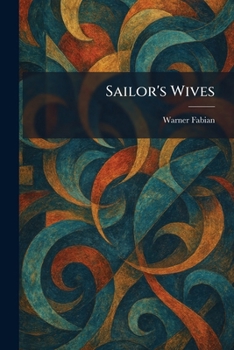
Sailor's Wives

"Sailor's Wives" is a compelling exploration of romance and social expectations set against the backdrop of the early 1920s. Written by Warner Fabian, the pseudonym of the celebrated author Samuel Hopkins Adams, this novel serves as a spiritual successor to the cultural phenomenon "Flaming Youth." It delves into the lives of young women navigating the complexities of marriage, independence, and the shifting moral tides of the Jazz Age.
The narrative follows characters caught between traditional domesticity and the allure of modern liberation, capturing the restless spirit of a generation defined by its rejection of Victorian constraints. With its sharp observation of high-society scandals and the internal struggles of its protagonists, "Sailor's Wives" offers a fascinating glimpse into the social dynamics of the post-war era. It remains a significant work of early 20th-century popular fiction, reflecting the anxieties and aspirations of an age in transition. Readers interested in historical melodrama and the evolution of social roles will find this a vivid and engaging portrait of 1924 society.
This work has been selected by scholars as being culturally important, and is part of the knowledge base of civilization as we know it. This work was reproduced from the original artifact, and remains as true to the original work as possible. Therefore, you may see the original copyright references, library stamps (as most of these works have been housed in our most important libraries around the world), and other notations in the work.
This work is in the public domain in the United States of America, and possibly other nations. Within the United States, you may freely copy and distribute this work, as no entity (individual or corporate) has a copyright on the body of the work.
As a reproduction of a historical artifact, this work may contain missing or blurred pages, poor pictures, errant marks, etc. Scholars believe, and we concur, that this work is important enough to be preserved, reproduced, and made generally available to the public. We appreciate your support of the preservation process, and thank you for being an important part of keeping this knowledge alive and relevant.
Customer Reviews
ThriftBooks ® and the ThriftBooks ® logo are registered trademarks of Thrift Books Global, LLC
