


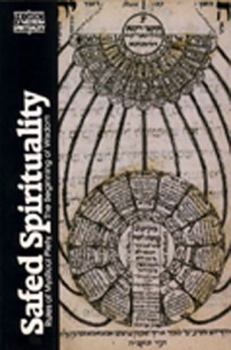
Safed Spirituality: Rules of Mystical Piety, the Beginning of Wisdom
(Part of the The Classics of Western Spirituality Series)

Select Format
Select Condition 
Book Overview
"...an undertaking of signal importance." Jacob Needleman Professor of Philosophy, San Francisco State University Safed Spirituality: Rules of Mystical Piety, The Beginning of Wisdom translated and introduced by Lawrence Fine preface by Louis Jacobs "Prepare the meal of the King. This is the meal of the Holy Ancient One, And the Impatient and the Field of holy apples. Behold, they come to share the meal with him." Isaac Luria (1534-1572) "The renaissance of Jewish mystical life which took place in the Galilean city of Safed in the sixteenth century is one of the most significant and remarkable chapters in the history of Judaism. The ideas which developed there, the rich literature which was produced, the stunning array of teachers which it nurtured, established Safed as one of the great centers of Jewish creativity." So writes Professor Lawrence Fine in the foreword of this volume. Collected here are the Hanhagot of Moses Cordovero, Abraham Galante, Abraham be Eliezer ha-Levi Berukhim, Joseph Karo, and Isaac Luria, plus the mystical-ethical treatise, Reshit Hokhmah (The Beginning of Wisdom) by Elijah de Vidas. In these writings the unique blend of kabbalistic tradition and messianic enthusiasm, which is characteristic of Safed spirituality, comes alive. The importance of the Safed tradition for today is perhaps best summed up by Louis Jacobs' description of the Safed mystics as "mighty God seekers; at times perhaps, over-credulous and superstitious from the contemporary point of view, but daring stormers of the heavens." Their intense devotional piety, their efforts to imbue even the most mundane event with religious meaning and their insistence on the cosmic significance of all human action make their thought a relevant, stimulating source of spiritual insight for our age. +
Format:Paperback
Language:English
ISBN:0809126125
ISBN13:9780809126125
Release Date:January 1984
Publisher:Paulist Press
Length:224 Pages
Weight:0.72 lbs.
Dimensions:0.6" x 6.0" x 9.1"
Customer Reviews
1 rating
Ancient wisdom, modern insight
Published by Thriftbooks.com User , 22 years ago
The book 'Safed Spirituality: Rules of Mystical Piety, The Beginning of Wisdom' is a text produced by the Paulist Press for their series on the Classics of Western Spirituality (see the end of this review for more information. The translation of these texts were done by Professor Lawrence Fine, who also wrote the introduction. At the time of its printing, Fine was a professor of religious studies and Jewish studies at Indiana University, and I took a course in Jewish mysticism under his direction. 'The renaissance of Jewish mystical life that took place in the Galilean city of Safed in the sixteenth century is one of the most significant and remarkable chapters in the history of Judaism. The ideas that developed there, the rich literature that was produced, the stunning array of teachers it nurtured, established Safed as one of the great centers of Jewish creativity.' Given this glowing introduction to the place and time, it is remarkable that few people, including few Jewish people, have ever heard of Safed or Safed spirituality. In the preface by Louis Jacobs, the idea of normative Judaism's resistance to things mystical is explored. Certainly in an era where Hasidic Jews are no longer unknown people and Kabbalistic mysticism is made popular by pop stars and New Age spiritualists, to explore the great production of the community of Safed makes sense. Safed spirituality had no qualms about reinventing the symbols, practices and traditions of Judaism, and in that has an interesting modern sensibility to it. However, the Safed community was careful not to push beyond the boundaries of `orthodox' Judaism, and so remains firmly a part of the greater Jewish communal experience. The Safed community benefited from a convergence of historical events, including the expulsion of Jews from various European kingdoms, most particularly the Spanish explusion of 1492, and from tolerance and trade within the Ottoman Empire at the time. Fine describes the Safed community of the 1500s as having five primary features that constituted innovations in Judaism: - messianic fervor - organised brotherhoods - ascetic behaviour - ritual innovations - contemplative practices Fine has selected two types of literature from the Safed community to present in this text. First, there is the Hanhagot, codes and practices of religious behaviour. Second, there is the Resh-it Hokhmah, which translates as The Beginning of Wisdom, an ethical-mystical text written by Elijah de Vidas. The Hanhagot are, in effect, practical daily instructions. This is not out of keeping with greater Jewish custom and practice, where writings such as the Talmud are esteemed for their organisation principles and exacting prescriptions for action and behaviour. 'Forsaking speculative, theoretical, and analytical concerns, the Haghanot are usually composed of lists that, in a terse, systematic format, enumerate practical behavioral standards and expectations. In tone they are conspicuously directive and did
Copyright © 2026 Thriftbooks.com Terms of Use
| Privacy Policy | Do Not
Sell/Share My Personal Information | Cookie Policy | Cookie Preferences | Accessibility Statement
ThriftBooks® and the ThriftBooks® logo are registered trademarks of Thrift Books Global, LLC
ThriftBooks® and the ThriftBooks® logo are registered trademarks of Thrift Books Global, LLC
