


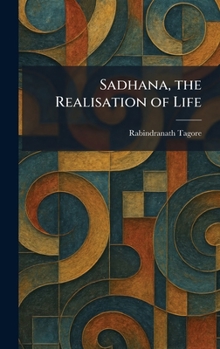
Sadhana, the Realisation of Life

"Sadhana, the Realisation of Life" is a profound collection of philosophical essays by the Nobel Prize-winning author Rabindranath Tagore. In this influential work, Tagore explores the relationship between the individual soul and the universe, drawing deeply from the ancient teachings of the Upanishads and the Buddha. The book serves as an invitation to understand the spiritual laws that govern human existence and the path toward attaining a state of harmony and enlightenment.
Through eight insightful chapters, Tagore examines themes such as the problem of evil, the realization of love, and the concept of action. He bridges the gap between Eastern mysticism and Western logic, presenting a vision where the finite human experience finds its ultimate meaning in the infinite. Tagore's lyrical prose illuminates the spiritual journey, emphasizing that true fulfillment comes not through isolation, but through a conscious connection with the divine and the natural world.
As a cornerstone of modern Indian philosophy, "Sadhana, the Realisation of Life" remains an essential text for those seeking a deeper understanding of spiritual growth and the unity of all life. It offers timeless wisdom on how to live with purpose, compassion, and a profound awareness of the sacred in the everyday.
This work has been selected by scholars as being culturally important, and is part of the knowledge base of civilization as we know it. This work was reproduced from the original artifact, and remains as true to the original work as possible. Therefore, you may see the original copyright references, library stamps (as most of these works have been housed in our most important libraries around the world), and other notations in the work.
This work is in the public domain in the United States of America, and possibly other nations. Within the United States, you may freely copy and distribute this work, as no entity (individual or corporate) has a copyright on the body of the work.
As a reproduction of a historical artifact, this work may contain missing or blurred pages, poor pictures, errant marks, etc. Scholars believe, and we concur, that this work is important enough to be preserved, reproduced, and made generally available to the public. We appreciate your support of the preservation process, and thank you for being an important part of keeping this knowledge alive and relevant.
Customer Reviews
ThriftBooks ® and the ThriftBooks ® logo are registered trademarks of Thrift Books Global, LLC
