


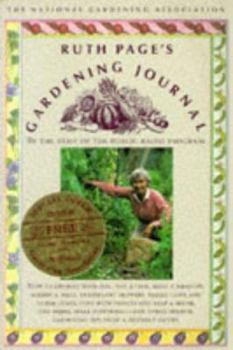
Ruth Page's Gardening Journal


Select Format
Select Condition 
Book Overview
No Synopsis Available.
Format:Paperback
Language:English
ISBN:0395500915
ISBN13:9780395500910
Release Date:January 1989
Publisher:Houghton Mifflin Harcourt
Length:204 Pages
Weight:2.50 lbs.
Dimensions:8.3" x 0.5" x 5.5"
Customer Reviews
1 rating
Light Reading
Published by Thriftbooks.com User , 20 years ago
This book is a collection of essays by Ruth Page, gardener, editor, and radio personality. Page prepared countless of these gardening essays for her radio program "The Gardening Journal". In her three and a half minute slots, she would describe a topic and get listeners fired up with a new solution or a new way of looking at their gardens. In this book, many of her early essays have been collated, edited, and loosely organized around the gardening year, extending from seed catalogs, to flowering trees, from vegetable varieties to Christmas cactuses. Topics covered include: starting seeds indoors, repotting house plants, planting trees, fertilizing, buying transplants, choosing flowers such as perennials or aromatic flowers, herbs and potpourri, insect pests and benefactors, saving seeds, harvest time, putting foods by, bulbs, extending the season, and fall garden cleanup. Since this is an informal book, there are no references or index. I've been a great fan of Page's for years. Her enthusiasm for gardening that one can hear in her voice on her radio spots is absolutely infectious. However, I was a little disappointed to see that the essays, at least the ones included in this collection weren't as substantial as I thought they would be. Her general approach to gardening, with its emphasis on organic techniques, is sound. But in some places, she seems to recite old beliefs instead of checking the facts. For instance, in her section about spinach, she refers to eating the "iron-rich leaves daily". But a check with a nutritional guide would reveal that spinach, while it contains some iron, isn't the most iron-rich green she could grow. In addition, the high oxalic acid content of spinach interferes with the absorption of calcium. She would be better-off growing amaranth, with twice the iron content as spinach, and no oxalic acid. Even butter-head lettuce and watermelon have more iron than spinach. In another section of the book, she cites a Cornell University study noting that pepper transplants seem to produce more peppers if they don't have peppers or flowers on them when transplanted. Hmmm...that may be true in the Ithaca area or in Page's zone 5 region where there is a relatively long growing season. But here on the zone 3-zone 4 border, things seem different. I started pepper seedlings from seed in early March, and transplanted them outdoors on June 1. Now it's mid-July and there's still no sign of flowers on my seedlings. Fortunately, I also purchased some pepper seedlings in June that already had flowers and tiny peppers on them. We've already enjoyed 3 peppers from these plants, and more peppers are on the way. As for my own seedlings, I'll be very lucky to get a few egg-sized peppers from them by first frost in late August-early September. It's clear that peppers need to be much more mature in this zone than those started in March in order for them to produce at all, and having or not having buds or peppers on them i
Copyright © 2026 Thriftbooks.com Terms of Use
| Privacy Policy | Do Not
Sell/Share My Personal Information | Cookie Policy | Cookie Preferences | Accessibility Statement
ThriftBooks® and the ThriftBooks® logo are registered trademarks of Thrift Books Global, LLC
ThriftBooks® and the ThriftBooks® logo are registered trademarks of Thrift Books Global, LLC
